About Lissachatina fulica (Bowdich, 1822)
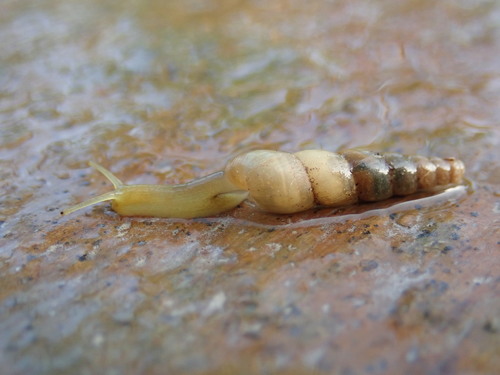
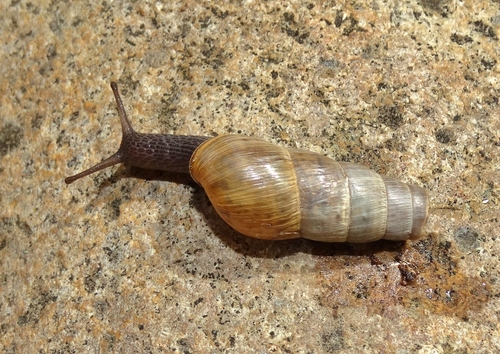
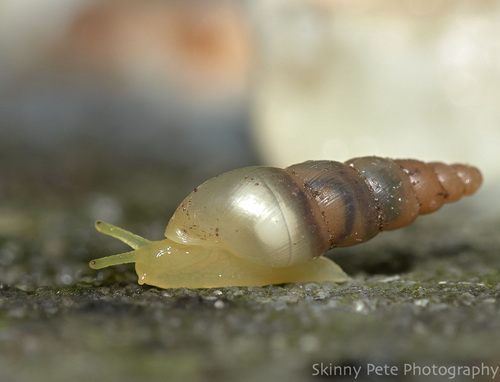
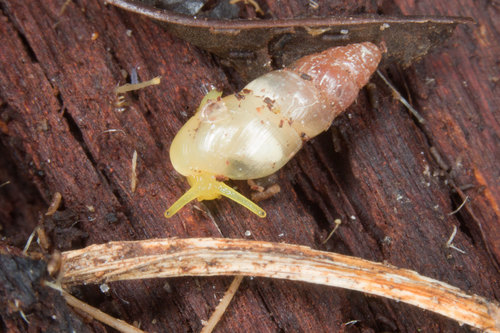
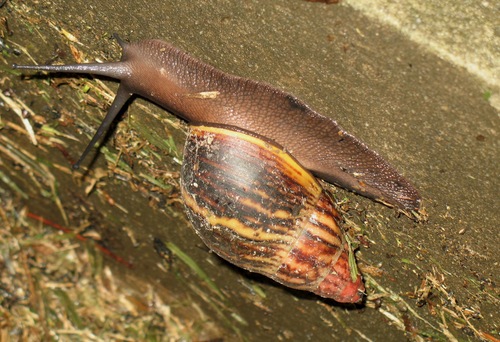
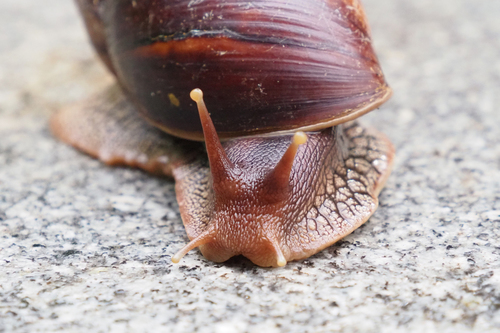
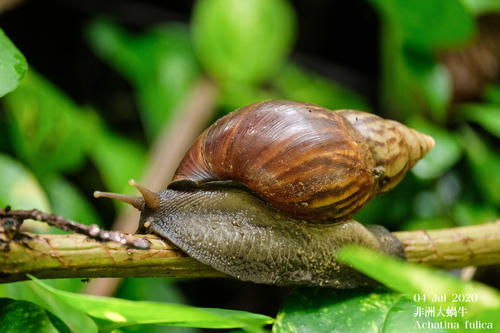
Lissachatina fulica, or the giant African land snail, has pure white, opaque eggs that can also be slightly yellowish or somewhat transparent. Its eggs have a thin calcareous shell, measuring about 5 mm long and 4 mm wide. A newly hatched individual is called a neonate; when it hatches, its shell is about 5 to 5.5 mm long and has 2.5 whorls. As the snail grows, its shell coils either clockwise, called dextral, or counter-clockwise, called sinistral, adding new whorls as it ages. Young snails have vertical brown and cream banded patterns on their shells that include wrinkles, welts, and criss-crossing markings. As the snail grows, new shell whorls become smooth, glossy, and solid brown. A fully adult giant African land snail reaches around 7 cm (2.8 in) in diameter and 20 cm (7.9 in) or more in length, making it one of the largest living land snail species on Earth. Adults typically have 7 to 9 whorls, but neither the number of whorls nor the width of the peristome, the lip of the shell around its opening, are reliable indicators of age, as both traits vary between individuals. While the species most commonly has a brown shell with cream sections at the apex, shell coloration is highly variable. Instead of the usual brownish-grey body and brown shell, individuals can have a buttery yellow body, also known as the pedal or foot; this variety is nicknamed the 'white jade snail' in China. There is also a 'golden' variety, sometimes considered an albino type, that has both a yellow body and yellow shell.
This species is native to East Africa, but has been widely introduced to other regions of the world via the pet trade, intentional movement as a food resource, and accidental transport. In Africa, its native range extends along the eastern coast of South Africa northward into Somalia. Some of its range in northern Africa, from northern Mozambique, Tanzania, and Kenya through Somalia into Ethiopia, may be the result of human introduction. The species had already been reported in Morocco, Ghana, and the Ivory Coast by the 1980s. In 1961, Albert R. Mead published the foundational work "The Giant African Snail: A Problem in Economic Malacology", which compiled all known information about the species and gave a detailed overview of its global distribution. Prior to 1800, the snail was already present in Madagascar; it spread west to Mauritius, reached Réunion in 1821, and arrived in the Seychelles in 1840. It was introduced to India in 1847, and reached Sri Lanka by 1900. It was present in northern Malaysia by 1911, most likely introduced from either India or Myanmar. It was first formally identified in Singapore in 1922, though it may have been present there as early as 1917. It was shipped to Java in 1925, and spread from there across Indonesia. It was first observed in Sarawak in 1928. It has been present in China since 1931, with an initial introduction point in Xiamen, and has also become established on Pratas Island, which belongs to Taiwan. It was established in Hawaii, United States, by 1936. It was present in Papua New Guinea by 1946, and spread from New Ireland and New Britain to the Papuan New Guinean mainland by 1976–77. It reached Tahiti by 1967, spread through New Caledonia and Vanuatu by 1972, and reached French Polynesia including American Samoa by 1978. It was reported in Samoa by 1990, and in the Federated States of Micronesia in 1998. L. fulica became established in the French West Indies in 1984, spread across Guadeloupe, and arrived in Martinique by 1988. Populations of L. fulica were reported in Trinidad in 2008, but had been greatly reduced by 2010. The snail was reported in Havana, Cuba in 2014. In Brazil, the first introduction of L. fulica occurred in 1988 in Paraná; by 2007, it had been recorded in 23 of the country's 26 states. The species was recorded in Ecuador's Pichincha region between 2006 and 2008, and may have been present on snail farms there for at least 10 years before that. Its presence in Colombia was reported between 2008 and 2009; while the timing of the initial introduction is unknown, it had been recorded in all regions of Colombia by 2012. Live specimens were found in Piura, Peru around 2008, and the snail may be present in Venezuela. It was reported in Puerto Iguazú, Argentina in 2010. It has been observed as an invasive species in Gyelposhing, Mongar, Bhutan since 2006, and its population there has increased drastically since 2008. In the contiguous United States, the snail was reported in Miami, Florida in 1966 and again in 2011; in both cases, eradication efforts took almost a decade to complete. Three separate introductions detected in June 2022 north of Tampa, December 2022 in Fort Myers, and June 2023 north of Miami are currently under quarantine, with eradication efforts ongoing.
Within its native African range, this snail occurs along the margins of forests. In areas where it has been introduced as an invasive species, it can be found in agricultural and urban areas. The snail prefers locations that provide shelter from light during the daytime and prevent desiccation, such as leaf litter or piles of debris. It will also climb tree trunks or walls when conditions allow. L. fulica lives in a wide range of temperate climates, and now occupies most regions of the humid tropics. It can tolerate a broad range of soil pH and calcium conditions, though calcium is essential for the development of its shell. Relative humidity, linked to rainfall levels, is an important factor for the snail's growth. The growth pattern of the snail's shell reflects rainfall patterns, similar to the growth rings of a tree. This species can tolerate temperatures from 0-9 °C (48.2 °F) up to 45 °C (113 °F), but grows best between 22 and 32 °C (71.6-89.6 °F). When conditions are too cold for activity, the snail burrows below the surface and does not lay eggs until temperatures rise above 15 °C (59 °F). This strategy to avoid extreme unfavorable conditions is called aestivation. The snail can survive in an aestivating state for up to three years by sealing itself inside its shell with a secreted calcareous compound that dries when exposed to air.