About Liriodendron chinense (Hemsl.) Sarg.
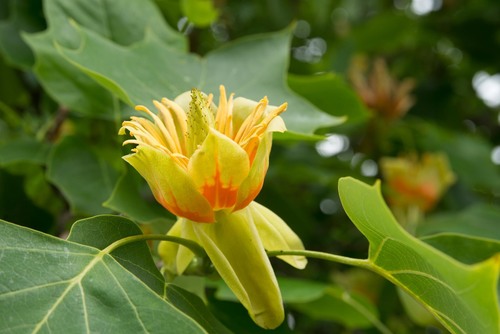
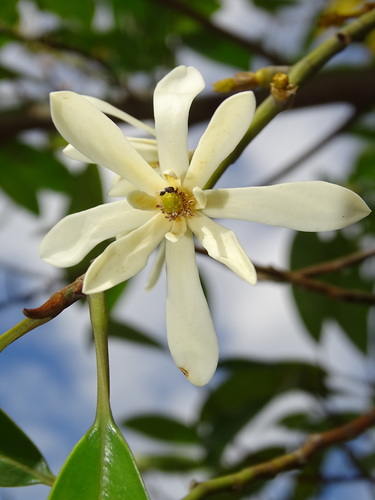
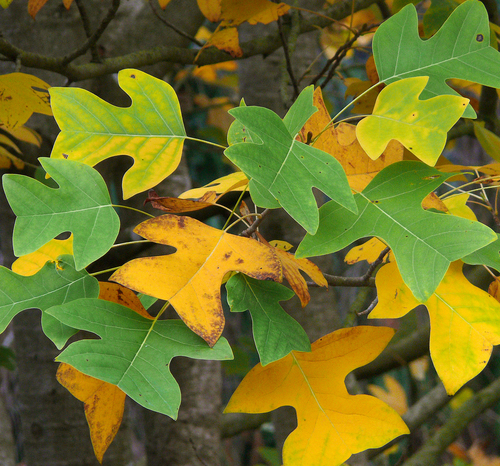
Liriodendron chinense, commonly called the Chinese tulip tree, is very similar to the American species Liriodendron tulipifera. It differs from L. tulipifera in that its leaves are often slightly larger and more deeply lobed, and its flowers have shorter inner petals that lack the orange pigment found in L. tulipifera. This species can reach around 40 metres (130 ft) in height. Most populations of Liriodendron chinense are deciduous; one semi-evergreen population has been identified in Mengla, Yunnan. Liriodendron chinense is not as cold-hardy as the American species, but it is cultivated as an ornamental tree on continents outside its native range. It is grown in England, where many specimens grow at Kew Gardens, as well as in Ireland, Belgium, the Netherlands, and Germany. In North America, it grows as far north as Boston, Massachusetts in the east, and Vancouver, British Columbia in the west. It is planted as a street tree at the University of Victoria and along Veterans' Memorial Parkway in Langford, British Columbia. A plantation of Liriodendron chinense is located at the National Arboretum in Canberra. When cultivated, this species grows at the same rate as the American tulip tree. A cultivar named J.C.Raulston, which has larger and darker leaves than typical Liriodendron chinense, has been developed in North Carolina. In the United Kingdom, L. chinense has received the Royal Horticultural Society's Award of Garden Merit.