About Lirabuccinum dirum (Reeve, 1846)
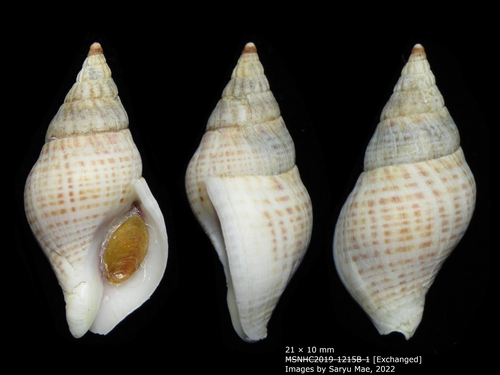
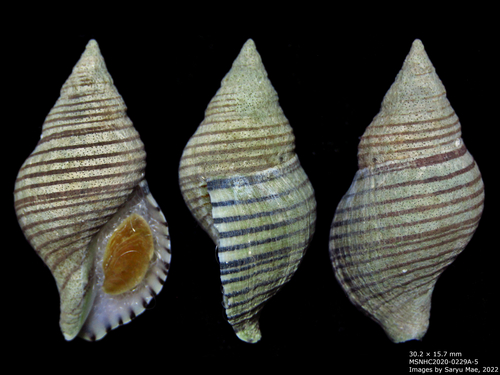
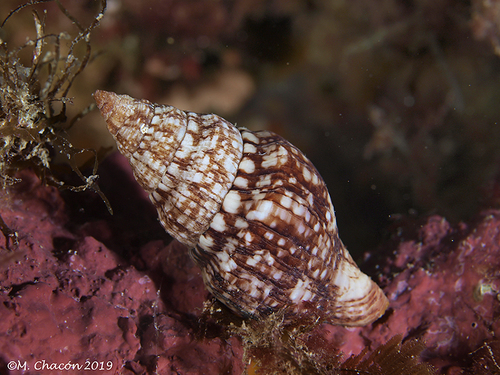
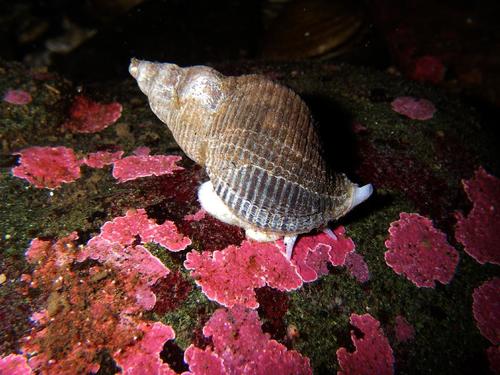
Lirabuccinum dirum (Reeve, 1846) is a medium-sized, elongated whelk that has a strong, heavy shell, reaching a maximum length of 45 mm (1.8 in). Its shell is made up of four or five whorls separated by shallow grooves, along with multiple rounded axial ribs that are most prominent on the spire. The first whorl of the adult shell, and the second whorl in young individuals, is covered in many narrow, evenly-spaced spiral ridges; these ridges are also visible on the inside of the outer margin of the shell's aperture. The aperture itself is an elongated oval shape, and can be closed by a horny operculum. A short siphonal canal is present to hold the snail's siphon, and the columella is polished and lacks folds. The species is most commonly grey or brownish-grey, though occasional individuals have an orange colouration. This whelk occurs in shallow waters of the northeastern Pacific Ocean, with a range that stretches from Chirikof Island in Alaska to Monterey Bay in central California. It is especially common in British Columbia, Washington state, and Oregon, but uncommon within California. It lives intertidally on rocky shores and in the shallow subtidal zone, and has been recorded as deep as approximately 35 m (115 ft) on Cobb Seamount. Besides inhabiting rocky surfaces, it can sometimes be found on gravel or mud near the base of rocks in bays. Lirabuccinum dirum is a predator and scavenger that feeds on winkles, limpets, mussels, barnacles, chitons, worms, and other invertebrates. It appears to specialise in feeding on dead or injured prey, and unlike many other whelk species, it does not seem capable of drilling through intact shells. When living in intertidal areas, the species is exposed to changing salinity levels, and it is particularly tolerant of low-salinity conditions. In fact, it actively seeks out low-salinity environments where other less tolerant organisms become stressed. It also feeds on carrion, and can extend its proboscis to feed on tubeworms inside their tubes, or to feed on prey that is being digested by the everted stomach of an ochre sea star.