About Lipaugus unirufus P.L.Sclater, 1860
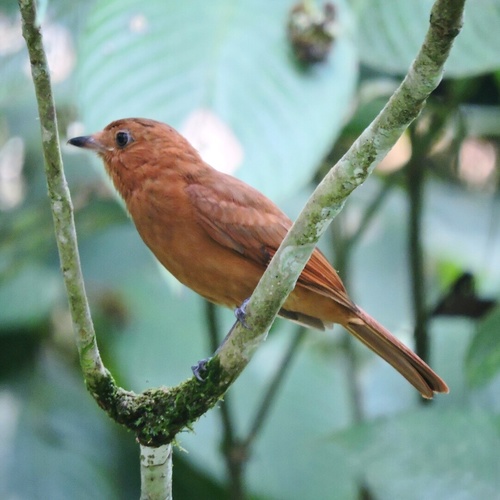
The rufous piha (scientific name Lipaugus unirufus P.L.Sclater, 1860) measures 22 to 26 cm (8.7 to 10 inches) in length. Six measured individuals weighed between 79 and 97 g (2.8 to 3.4 oz). Males and females have identical plumage. Adult birds of the nominate subspecies have a rufous crown with thin, somewhat lighter streaks. The rest of the face and the upperparts are deep cinnamon brown. The wings and tail are also deep cinnamon brown, and the inner webs of the remiges are deep ochraceous buff. The underparts are buffy cinnamon, with a darker and duller tone on the breast. Subspecies L. u. castaneotinctus has darker, more chestnut-toned cinnamon upperparts than the nominate subspecies. Both subspecies have a dark brown iris, a dusky gray upper mandible, a dull buffy brown lower mandible with a gray tip, and legs and feet that range from gray to brown. The rufous piha resembles the rufous mourner (Rhytipterna holerythra) and the speckled mourner (Laniocera rufescens), and all three species overlap across much of their ranges. Of the two subspecies, the nominate subspecies of the rufous piha has a much larger range. It occurs from southern Veracruz and northern Oaxaca in southern Mexico, extending south along the Caribbean slope through Belize, Guatemala, Honduras, Nicaragua, Costa Rica, and Panama. From Panama, it ranges further south into western Colombia, and east within Colombia to the middle of the Magdalena River valley. It also has a separate population on the Pacific slope, from central Costa Rica extending slightly south into Panama. Subspecies L. u. castaneotinctus is found from far southwestern Colombia's Cauca Department into northwestern Ecuador's Esmeraldas Province. The rufous piha mainly lives in humid evergreen forest and mature secondary forest in tropical lowlands. It is occasionally found in more open areas with scattered trees. Its elevation range varies by region: from sea level up to 1,100 m (3,600 ft) in northern Central America, up to 1,200 m (3,900 ft) in Costa Rica, up to 1,500 m (4,900 ft) in Colombia, and up to 700 m (2,300 ft) in Ecuador.