About Liparis liliifolia (L.) Rich. ex Lindl.
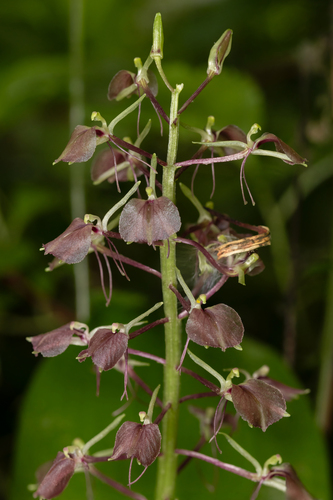
One of the common names for Liparis liliifolia, lily-leaved twayblade, originates from the plant’s two connected basal leaves. These leaves are light green, smooth, oval-shaped, and feature a partial midrib. The plant produces delicate mauve or purple flowers, which grow in a loose cluster on a stem that reaches 4–10 inches (100–250 mm) tall, with a total of up to 31 flowers per stem. Its petals and sepals are long, thin, and often droop. Rarely, flowers may be green instead of the typical mauve or purple. Each flower has a wide, flat, nearly translucent labellum that is pale purple with darker veins. The plant’s fruit is smaller than its pedicels. Its seeds can only germinate and grow when associated with a specific mycorrhizal fungus that occurs across the species’ range. For decades, botanists debated whether the specific epithet should be spelled with one or two consecutive i’s, but botanist Bernard Boivin has now shown the correct spelling to be liliifolia. This orchid is native to eastern Canada (Quebec and Ontario) and the eastern United States. Within the eastern United States, it occurs in the Appalachians, Ozarks, the Great Lakes region, and the Ohio and Upper Mississippi Valleys, and it is absent from the southern coastal plains. It inhabits forests, shrublands, thickets, woodlands, and mountains, and can be found at altitudes up to 4,200 feet (1,300 m) in mountain areas. While the species is considered globally secure, populations are declining and it is rare or endangered in many northeastern U.S. states. It is common throughout most of its range. This orchid is pollinated by flies, potentially including the species Pegoplata juvenilis. It has also been suggested that unspecialized insects may pollinate the orchid. The North American Orchid Center notes that insects with long legs or long mouthparts may be able to pollinate its flowers. Threats to the species include beaver-caused flooding, drainage of swamp habitat, and insecticides that kill the fly species that pollinate the plant.