About Liopholis whitii (Lacépède, 1804)
White's skink (scientific name Liopholis whitii (Lacépède, 1804)) is a stocky, slow-growing, medium-sized skink species. It reaches a maximum snout-to-vent length (SVL) of about 90 mm (3.5 in). Both males and females reach sexual maturity at a snout-to-vent length of approximately 75 mm (3.0 in), a size that is typically achieved when individuals are three years old, though they may mature earlier when kept in captivity.
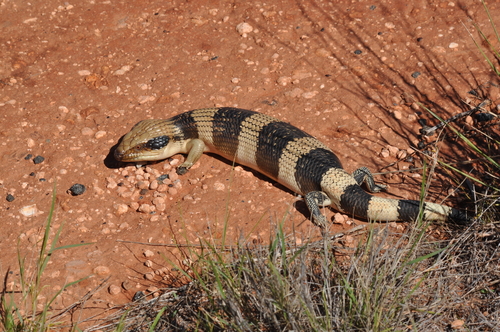
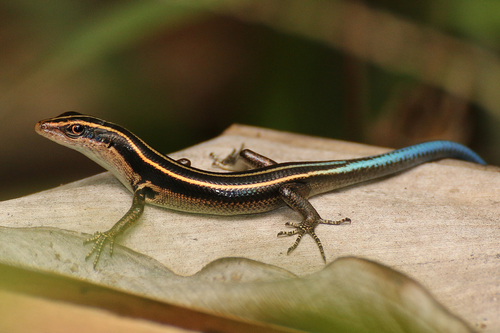
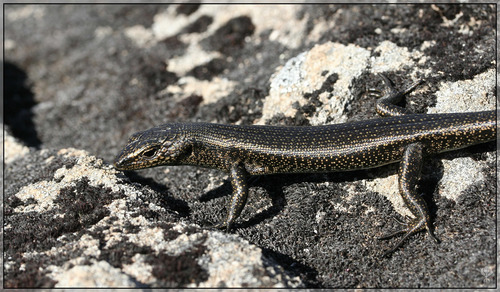
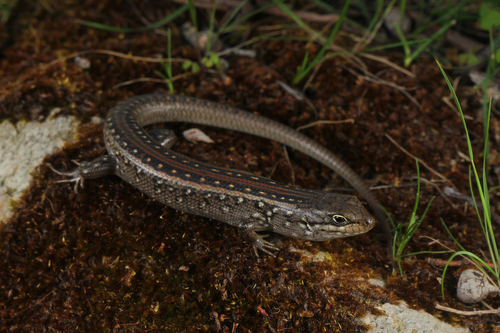
This species displays a high degree of variation in colour and pattern. Some populations have no patterns on the back and no stripes on the lips. The base colour of the central back stripe ranges from grey to brown to red. The sides of the body are patterned with black and white rosettes, set against a grey to brown background. The underbelly is pale peachy-orange, with colour intensity increasing toward the tail and along the undersides of the limbs.
The back is patterned with three stripes: the central stripe is solid brown, and it is paralleled on both sides by black stripes that contain a sequence of white spots. These stripes terminate at the base of the head and the base of the tail. The head and tail are typically brown, with no additional patterning and only minimal outlining of the scales. Most specimens have black stripes running along both sides of the lips, extending from the yellow-edged eyes to irregular speckling on the bottom of the chin. Lip patterns vary between individuals, and some lack lip stripes entirely.
Liopholis whitii is widespread across south-eastern Australia, including Tasmania and many Bass Strait islands. Its natural habitats include forest, shrubland, and rocky areas, found at altitudes ranging from sea level up to 1,200 m (3,900 ft). It prefers habitats with rocks and shrubby heathland that have minimal environmental disturbance.