About Liopholis multiscutata (Mitchell & Behrndt, 1949)
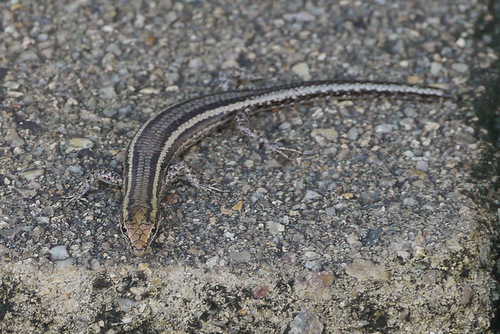
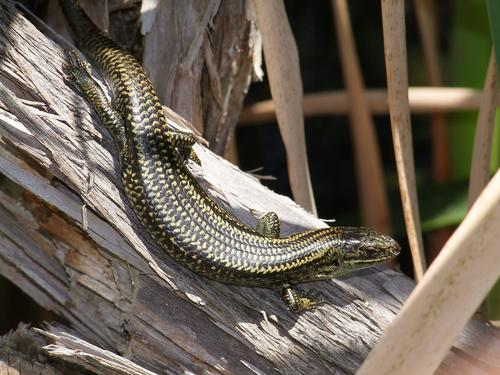
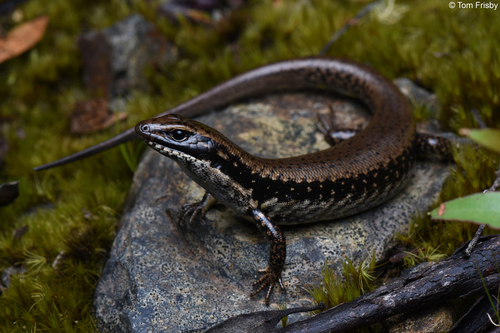
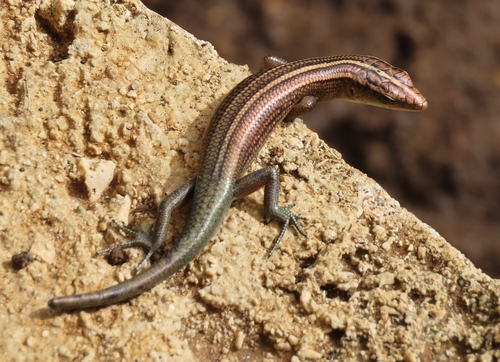
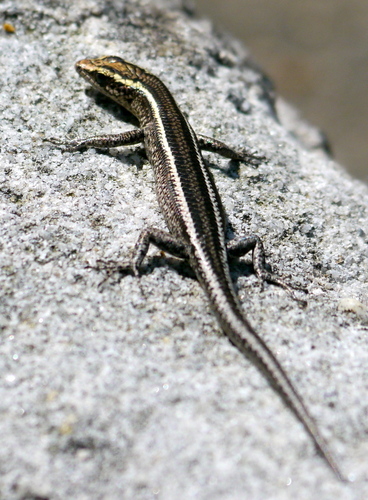
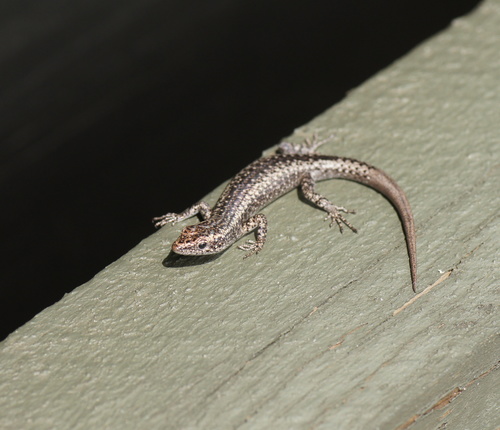
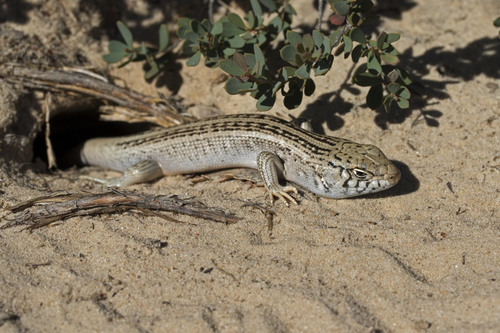
Liopholis multiscutata, commonly called the southern heath (bull) skink, is a medium-sized skink with a robust build. Its dorsal coloration ranges from sandy to reddish-brown, and adult individuals reach a snout-vent length of 80 to 95 millimeters. This species shows clear sexual dimorphism: males are typically larger and more brightly colored than females. It resembles the closely related Liopholis whitii, but can be distinguished by several consistent physical traits. In mature L. multiscutata, the interparietal scale on the top of the head is as wide as, or wider than, the frontal scale. The subdigital lamellae, the scales located under the toes, have a bicarinate, or two-ridged, texture. The species also has two or three rows of small white or yellow spots within the dark dorso-lateral stripe that runs along its back. Unlike L. whitii, the flanks of L. multiscutata have mixed pale and dark scales that rarely form distinct eye-like markings called ocelli. It has 37 to 46 smooth scale rows at mid-body. This skink is endemic to southern Australia. Its range covers western Victoria, Kangaroo Island, the Eyre and Yorke Peninsulas in South Australia, and extends to coastal areas of southern Western Australia, including many offshore islands. In Victoria, the species is restricted to four small, highly isolated populations that live in semiarid mallee dunefields. The primary habitats of the heath skink are open forest, low open woodland (often with rock outcrops), coastal dunes, and heathlands. It is a cryptic, burrowing species specialized to live in sandy or loamy soils. It builds complex connected tunnel networks called warrens, most often on and around large sand dune crests. Like warrens built by other species in the Liopholis genus, these structures usually have multiple entrances and are positioned at the base of small to medium-sized shrubs. All known heath skink populations in Victoria are located within the Lowan Mallee bioregion, where they occur in the Mallee Heath Ecological Vegetation Class, a low open scrubland habitat with heathy shrubs dominated by Banksia ornata (desert banksia), Leptospermum myrsinoides (heath tea tree), and Callitris verrocusa (scrub cypress pine).