About Liopholis inornata (Rosén, 1905)
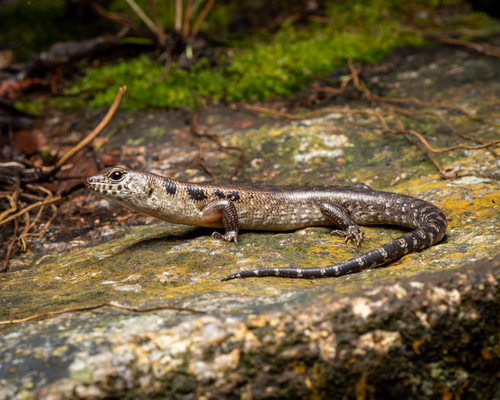
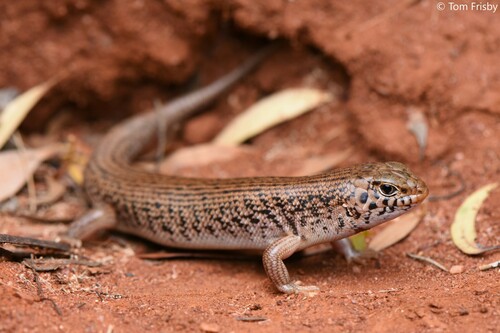
Liopholis inornata, commonly known as the desert egernia, is a medium-sized terrestrial skink. Its back and sides range from pale to reddish-brown, with cream-colored spots along the tips of its scales; scale color typically darkens closer to the head. The underside and ventral area are pale, ranging from creamy white to yellow, and its limbs are often paler than the rest of its body. Like most burrowing lizard species, the desert egernia has a narrow body and strong, small legs that improve burrowing efficiency and reduce energy use. Its tail is usually slightly longer than its snout-vent length, is round and tapering, and matches the body’s color with very little variation. A key identifying feature of this species is that its fourth toe is substantially longer than its third toe. Adult desert egernias generally measure 75 to 84 millimeters from snout to vent, and 165 to 184 millimeters from snout to tail, with no significant size difference between males and females. Unlike many other skink species, the desert egernia does not show color pattern polymorphism; this absence may be explained by the heterogeneous nature of Australian arid areas, and the species’ effective camouflage against local habitat soils that helps it avoid predators. Most of the desert egernia’s range covers central Western Australia, most of inland South Australia, southern Northern Territory, south-west Queensland, western New South Wales, and a small portion of north-west Victoria. Because of its large distribution and relative abundance, the IUCN Red List has assessed the desert egernia as Least Concern for extinction. However, the species is protected by state legislation in Victoria, where it is classified as threatened due to its very small local range. The desert egernia is a xerocole, with numerous adaptations for living in dry, arid areas. It is an obligate burrower, meaning it exclusively lives in burrows that it constructs itself, an adaptation to the harsh arid climate it inhabits. It is most commonly active from crepuscular to nocturnal periods, but it may also be active during the day to bask, or to forage when conditions make termites most active. The species typically lives in areas with deep, uncompacted sandy or loamy soils, and occurs more often higher on sand ridges than its close-range relatives like the Night Skink (Liopholis striata). The desert egernia’s burrow is generally less complex than burrows built by other xerocole lizard species. Burrows are usually 30 to 50 centimeters deep, and marked by fanned sand surrounding at least one entrance, or occasionally piled in a nearby clump of grass. The simplest burrow configuration is U-shaped with two entrances: one entrance is exposed, while the other is covered by a thin layer of soil. Researchers hypothesize that the covered second entrance allows the desert egernia to escape from predators such as snakes and sand goannas, which know that blocking the only known entrance will trap the lizard inside. In some regions, such as the Simpson Desert, the desert egernia builds complex burrows with multiple exposed entrances. Burrow entrances most often face north or north-west; this may act as a temperature regulation strategy, since the desert egernia rarely travels far from its burrow, and entrances with these orientations receive an appropriate amount of sunlight. Before winter begins, the species often seals burrow entrances to support thermoregulation during hibernation. The desert egernia frequently moves between different burrow sites. In addition to being a xeric environment specialist, the desert egernia is considered a fire specialist: it is often found in greater numbers in recently burned sites than in sites that have not had fire for many years. The desert egernia is viviparous, meaning it gives birth to live young. Its breeding season usually runs from September to early May, and it can produce two litters in a single breeding season. Litters typically contain 1 to 4 offspring, with an average litter size of 2.1. This small litter size, compared to other Liopholis species, is attributed to the desert egernia’s relatively small body size. The species reaches sexual maturity within two years, and is thought to be mostly monogamous. Unlike most other members of Liopholis (and the former Egernia genus), which are typically social and live in family groups, the desert egernia is a solitary species that does not form significant social associations with other members of its own species, its offspring, or related Liopholis species.