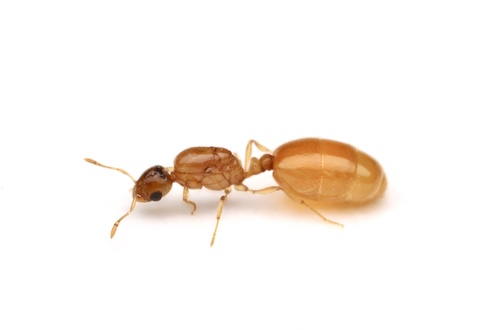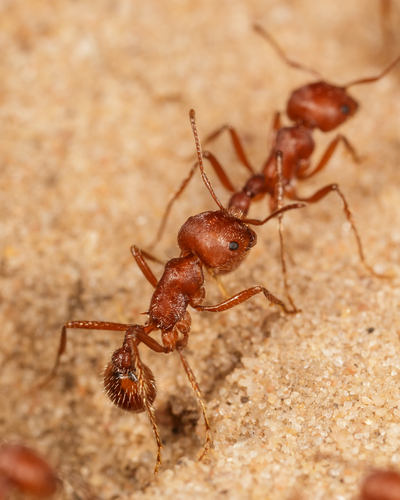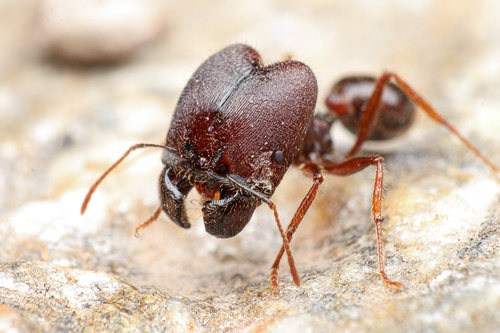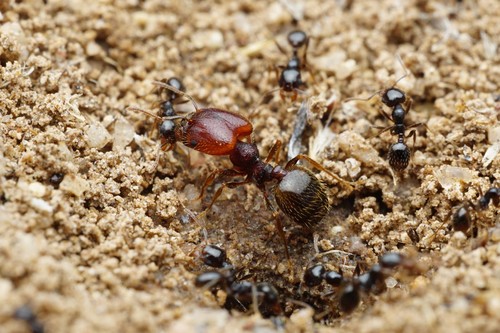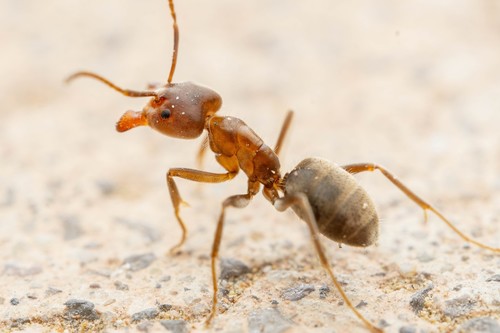
About Liometopum apiculatum Mayr, 1870
Liometopum apiculatum Mayr, 1870 is a species of ant belonging to the subfamily Dolichoderinae. This ant occurs in arid and semi-arid regions ranging from the southwestern United States through Mexico, as far south as Quintana Roo. Its geographic range extends from Colorado through Texas, New Mexico, and southeastern Arizona, continuing south into Mexico. It is typically found at elevations between 1,000 and 2,500 metres (3,300–8,200 ft), with its prime habitat being oak forests located around 2,000 m (6,600 ft). At higher elevations, it occurs in pinyon pine zones, reaching as far as ponderosa pine and riparian zones; at lower elevations, it lives in creosote bush scrub and grasslands, making its microhabitats in clay, under rocks and boulders, and within decaying logs. It has also been recorded in foothill meadows, deciduous canyon forests, pinyon-cedar woodlands, ponderosa pine-cedar-oak woodlands, and cottonwood–willow forests. At high elevations, L. apiculatum becomes less abundant and is replaced by the related species L. luctuosum. Altitude appears to play an important role in shaping the distribution of Liometopum ants. In regions of Mexico explored by Conconi et al. (1983b), both L. luctuosum and L. apiculatum are only found between 2,000 and 3,000 m (6,600 and 9,800 ft); the species are absent from areas below 1,800 m (5,900 ft), even where habitat conditions appear favorable. In the United States, L. apiculatum occurs at elevations from 1,316 to 2,438 m (4,318 to 7,999 ft). For reproduction, immature stages of reproductive ants are found in L. apiculatum nests from May to August, while all brood is worker caste during the rest of the year. Males and reproductive gynes have been collected outside the nest from June to August, and founding queens have been collected under stones and other landscape features in July and August. Nuptial mating flights of this species take place during the day after a heavy rain, in the months of April or May. Before a nuptial flight, worker ants become greatly agitated, leave the nest, and run rapidly in a zig-zag pattern. Male and female alate winged ants leave the nest but are less active than workers. After some time, workers begin biting the legs and wings of the alates, forcing them to climb the nearest plant. Workers continue to stimulate alates with bites until the alates start beating their wings, then take flight one by one rather than in a single swarm. Mating occurs in the air, and mated males and females fall to the ground together, often still attached. Queens of L. apiculatum have a shorter lifespan than queens of L. luctuosum, though the exact difference in lifespan is not specified. However, L. apiculatum queens have greater oviposition productivity than L. luctuosum queens. The annual productivity of an established L. apiculatum colony containing 60,000 to 85,000 workers is approximately 3–3.6 kilograms (6.6–7.9 lb) of brood per year. Founding queens lay a large number of eggs initially, but only a small percentage of these eggs reach adulthood in the first F1 generation, partially because smaller trophic eggs are consumed as food by the colony. After laying her first batch of eggs, the queen delays laying more eggs until the first batch has developed into pupae. Once the first workers emerge, the queen stops laying trophic eggs. This reduces the total number of eggs she lays, but increases the proportion of viable eggs. Eggs are laid year-round. Some virgin L. apiculatum queens leave the nest, remove their wings, dig a new nest without mating, then lay eggs, care for the eggs, and eat existing eggs to survive. These virgin queens only care for more recently laid eggs that have not turned yellow or dried out. A 1983a study by Conconi et al. recorded the longevity of each reproductive caste and the process of colony foundation in L. apiculatum, examining the species' life cycle under different conditions of humidity, temperature, and substrate. Ant queens were placed either in glass tubes with moist cotton or in jars with soil, and held at varying temperatures and relative humidity. The observed longevity of each reproductive caste was as follows: males lived 15 to 37 days, virgin queens lived 19 to 268 days, and fertilized queens lived 17 to 316 days. The recorded lifespan for fertilized queens is very short for an ant queen, so this suggests either that L. apiculatum is highly polygynous, or that queens live much longer in wild conditions.