About Linnaea borealis L.
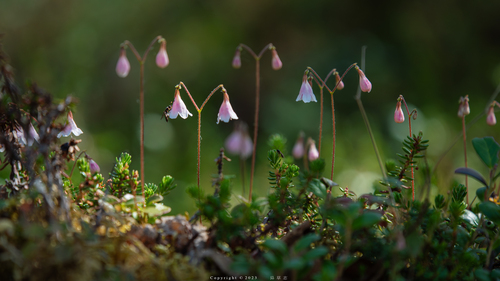
Linnaea borealis L. is a perennial plant with slender, hairy, prostrate stems that grow 20 to 40 centimeters (8 to 15 and a half inches) long. It bears opposite evergreen leaves that are rounded oval in shape, measuring 3 to 10 millimeters (1/8 to 3/8 of an inch) long and 2 to 7 millimeters (1/16 to 1/4 of an inch) broad. Its flowering stems curve upward, reach 4 to 8 centimeters (1 and a half to 3 and a quarter inches) tall, and are leafless except at their base. The flowers grow in pairs, hang downward, and are 7 to 12 millimeters (1/4 to 1/2 of an inch) long, with a five-lobed pale pink corolla. L. borealis is self-incompatible, meaning it requires cross-pollination to produce viable seeds. Because pollen usually does not disperse very far, individual plants and clonal colonies can become reproductively isolated. No matter whether seeds are produced or not, Linnaea plants in a specific area often spread via stolons to form clonal patches that all share the same genotype. Linnaea borealis has a circumpolar distribution, growing in moist subarctic, boreal, or cool temperate forests. It extends further south at higher elevations in various mountains: in Europe it reaches south to the Alps, in Asia south to northern Japan, in North America it reaches south to northern California, Arizona, and New Mexico in the west, and to West Virginia (and was formerly found in Tennessee) in the eastern Appalachian Mountains. Clonal stands of Linnaea can persist for a very long time; in some locations, they remain alive even when no seeds are produced, or when seedling germination or establishment does not happen. The species was likely common in areas south of its current range during Pleistocene Ice Age glaciations. Its clone-forming perennial growth habit has allowed it to survive locally in this former range through the following millennia in various cool, moist high-elevation habitats, including algific talus slopes with persistent underground periglacial ice.