About Linckia columbiae Gray, 1840
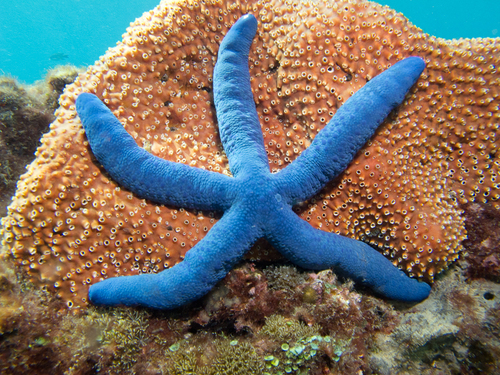
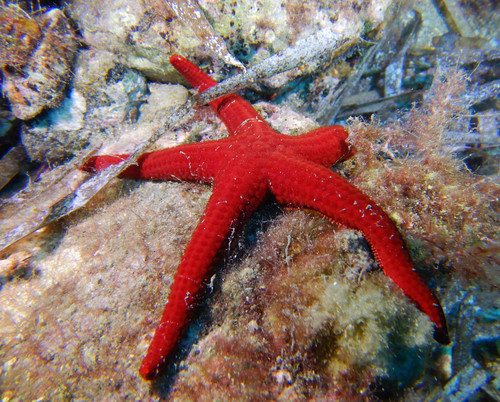
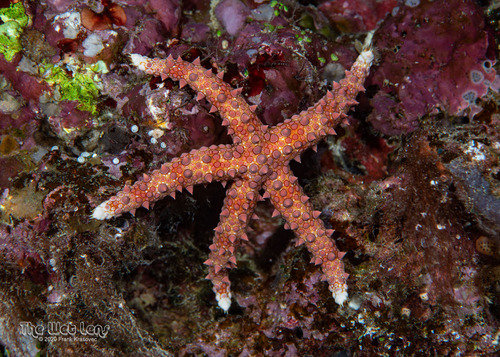
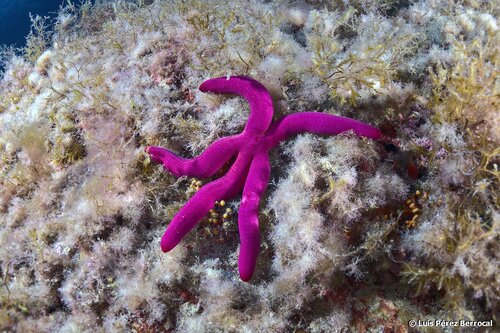
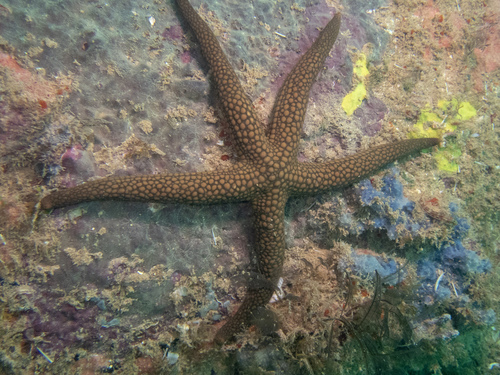
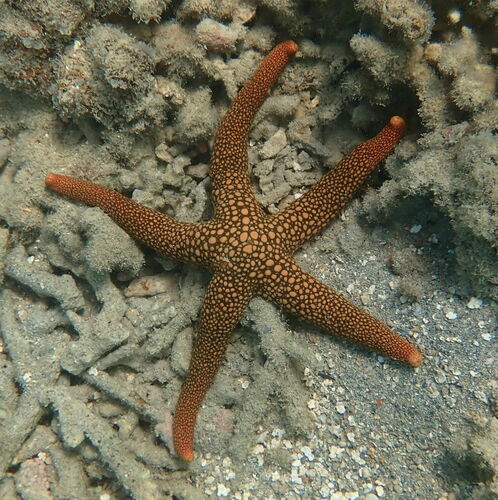
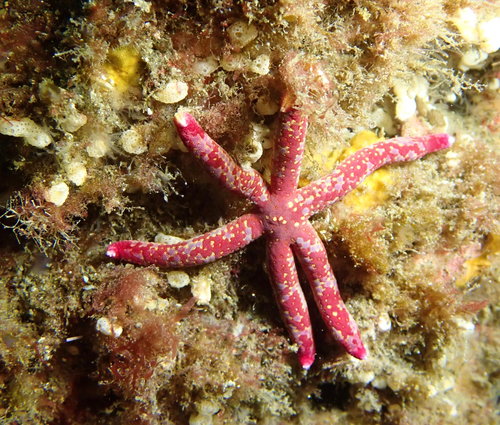
Linckia columbiae Gray, 1840 can grow to 10 cm (4 in) across. This species shows great variation in colour, shape, and even the number of rays. Writing in 1904, Monks noted that out of over 400 specimens he examined, no more than four were symmetrical, and no two specimens were alike. The normal number of rays for this species is five, but some specimens have only one ray, while others have four, six, seven, or even nine. Its disc is small, with one or two madreporites that are usually oval and vary in size. Its long, cylindrical rays have blunt, triangular points that curve slightly upward at the tip. The entire surface is covered in hemispherical granules, which are larger near the ambulacral grooves. This species has two rows of ambulacral plates, a trait that distinguishes it from the very similar Linckia guildingi, which has three rows of ambulacral plates. Its colour is typically a mottled combination of grey and red, with several rows of tiny yellow stars running lengthwise down each ray. Linckia columbiae occurs in the East Pacific Ocean. Its range extends from San Pedro, California (USA) and the Gulf of California (Mexico) to northwest Peru. It is also found on offshore East Pacific islands including the Galápagos, Clarion Island, and Cocos Island. It inhabits rocky substrates in the intertidal zone, and can be found at depths down to approximately 150 m (500 ft).