About Linaria flavirostris (Linnaeus, 1758)
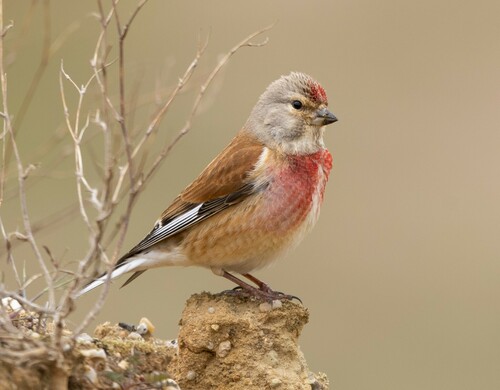
This species, commonly known as the twite, has a scientific name of Linaria flavirostris (Linnaeus, 1758). In size and shape, the twite is similar to the linnet, with a total length of 13 to 13.5 cm (5.1 to 5.3 in). Unlike linnets and redpolls, it does not have a red head patch or red breast. Its upperparts are brown with black streaking; adult males have a pink rump, while immature and female twites have a brown rump. The underparts range from buff to whitish, with brown streaking. The species' characteristic conical bill is yellow in winter and grey in summer. The twite's name comes from its very distinctive nasal 'twaa-it' call, and its song includes fast trills and twitters. Outside of the breeding season, twites often form large flocks, and will sometimes mix with other finch species on coasts and salt marshes. They feed mainly on seeds. Subspecies of twite vary in plumage tone, following Gloger's rule: L. f. pipilans, found in the hyper-humid oceanic climate of Britain and Ireland, is the darkest subspecies, while the nominate subspecies L. f. flavirostris from Scandinavia is the next darkest. Asian subspecies, which live in much drier mountain habitats, are much paler. The twite breeds in northern Europe, and across the Palearctic extending to Siberia and China. For breeding, it favours alpine grassland and low shrubland. In the Asian portion of its range, it breeds at high to very high altitudes, between 3,600 and 4,900 m. In the much cooler oceanic summer climate of northwestern Europe, it breeds at much lower elevations, and can be found down to sea level in northwestern Ireland, western and northern Scotland, and Norway; in this region, it is strongly associated with traditional low-intensity farming on coastal machair grassland. The twite is partially resident, and many individuals migrate further south or move to coasts for the winter. The species has declined sharply in parts of its range, most notably in Ireland.