About Limulus polyphemus (Linnaeus, 1758)
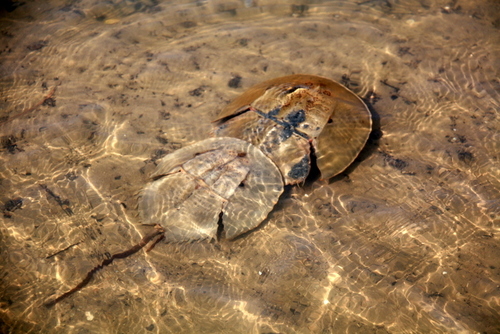
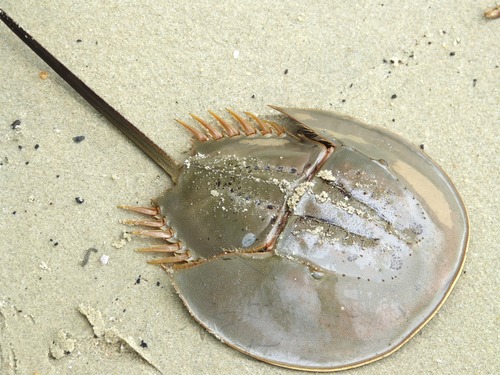
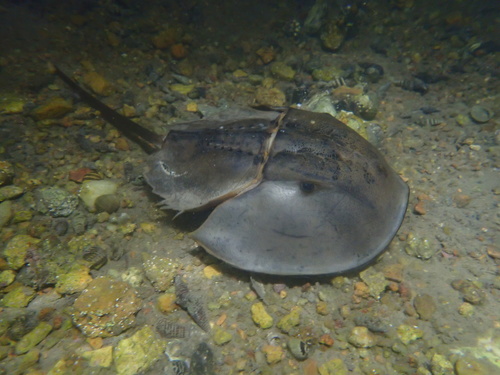
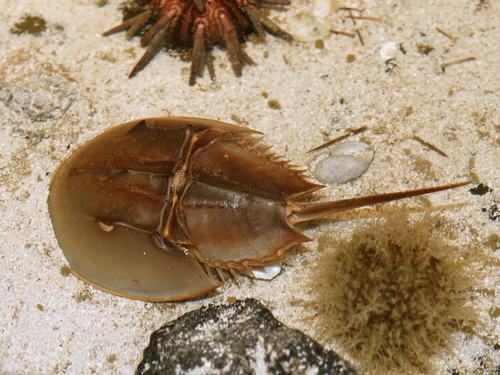
The Atlantic horseshoe crab (Limulus polyphemus), also called the American horseshoe crab, is a species of horseshoe crab, a type of marine and brackish chelicerate arthropod. It is found in the Gulf of Mexico and along the Atlantic coast of North America, with Delaware Bay along the South Jersey Delaware Bayshore serving as its main annual migration area. Native Americans once ate its eggs, and today this species is caught for use as fishing bait, in biomedicine (most notably for producing Limulus amebocyte lysate), and in scientific research. It plays a key role in local ecosystems: its eggs are an important food source for shorebirds, while juvenile and adult Atlantic horseshoe crabs are prey for sea turtles. Three other living (extant) species of horseshoe crab in the family Limulidae are all restricted to Asia. Despite their common name, horseshoe crabs are more closely related to arachnids like spiders and scorpions than to true crabs or other crustaceans.
The Atlantic horseshoe crab is the only extant horseshoe crab species native to the Americas, though other extinct species known only from fossil remains have been found in this region. All living Asian horseshoe crab species are quite similar in form and behavior to L. polyphemus; these Asian species are Tachypleus tridentatus, Tachypleus gigas, and Carcinoscorpius rotundicauda. Most Atlantic horseshoe crabs live along the Atlantic East Coast of the United States, ranging from Maine to Florida. Along the U.S. Gulf Coast, they are found in Florida, Alabama, Mississippi, and Louisiana. Outside the United States, the only established breeding population is on Mexico’s Yucatán Peninsula, where it occurs along the western, northern, and eastern coasts. Individuals are rarely seen outside this breeding range, with only a few recorded sightings from Canada’s Atlantic coast (Lahave Island, Nova Scotia), the Bahamas, the Turks and Caicos, Cuba, and the western Gulf of Mexico (Texas and Veracruz). Historic claims of Atlantic horseshoe crabs on Jamaica and Hispaniola (the Dominican Republic’s southeast coast) have not been confirmed by subsequent expeditions to these areas. Attempts to introduce this species to Texas, California, and the southern North Sea all failed to produce established populations. Recorded sightings from Europe, Israel, and Western Africa are considered to be released or escaped captive individuals.
Atlantic horseshoe crabs inhabit areas from shallow coastal habitats such as lagoons, estuaries, and mangroves to depths of more than 200 meters (660 feet) up to 56 kilometers (35 miles) offshore. Evidence suggests they prefer depths shallower than 30 meters (98 feet). Their temperature preference varies by population, with the northernmost populations being the most cold-resistant: populations in New Hampshire’s Great Bay show increased activity when water temperatures are above 10.5 °C (51 °F), while populations in Delaware Bay are active above 15 °C (59 °F). In contrast, these northern populations do not tolerate warm temperatures as well as the species’ southern populations. Atlantic horseshoe crabs can survive in waters ranging from brackish (nearly fresh water) to hypersaline (almost twice the salinity of sea water), but their optimum growth occurs at salinities around or slightly below full sea water (20–40‰). A 2022 study of ancient Early Pleistocene (2 million year old) environmental DNA from the Kap Kobenhavn Formation of northern Greenland identified preserved DNA fragments of horseshoe crabs assigned to L. polyphemus. This finding suggests that horseshoe crabs ranged and spawned as far north as Greenland during this period of warmer conditions, when sea surface temperature was around 8 °C warmer than it is today. These DNA fragments are among the oldest ever sequenced.
Atlantic horseshoe crabs feed on mollusks, annelid worms, other benthic invertebrates, and pieces of fish. Lacking jaws, they grind food using bristles on their legs and a gizzard that holds sand and gravel. Spawning typically takes place in the intertidal zone and correlates with spring tides, the highest tides of each month. The breeding season varies by location: northern populations (all in the United States except those in southern Florida) generally breed from spring to autumn, while southern populations (southern Florida and the Yucatán Peninsula) breed year-round. In northern populations, breeding is triggered by rising temperatures, while the opposite is true for the southernmost population on the Yucatán Peninsula, where falling temperatures stimulate breeding. In Massachusetts, horseshoe crabs spend winter on the continental shelf and emerge to spawn on shorelines in late spring, with males arriving first. The smaller male uses a “boxing glove”-like structure on its front claws to cling to the back of a female, and often remains attached for months. It is common for multiple males to attach to a single female. Females reach the beach at high tide. After a female lays a batch of eggs in a nest 15–20 cm (6–8 in) deep in the sand, attached males fertilize the eggs with their sperm. The total number of eggs a female produces depends on her body size, and ranges from 15,000 to 64,000 eggs per female.
Development starts when the first egg covering splits, and a new transparent spherical capsule is formed from a membrane secreted by the embryo. Larvae develop and swim for approximately five to seven days. After this swimming stage, the larvae settle and undergo their first molt, which occurs about 20 days after the egg capsule forms. As young horseshoe crabs grow, they move into deeper waters, where they continue to molt. They must shed their shells around 17 times before reaching sexual maturity at approximately 9 years of age. In the first 2–3 years of life, juveniles remain in shallow coastal waters near the breeding beaches. While longevity is hard to measure, the average lifespan of L. polyphemus is thought to be 20–40 years.
Research from the University of New Hampshire has provided new insight into the circadian rhythm of Atlantic horseshoe crabs. Multiple studies have examined how a circa-tidal rhythm affects this species’ locomotion. While it has long been known that a circadian clock system controls the sensitivity of the species’ eyes, scientists have discovered a separate clock system that controls locomotion. When a sample of Atlantic horseshoe crabs was exposed to artificial tidal cycles in a laboratory setting, circa-tidal rhythms of locomotion were observed. The study found that light and dark cycles do influence locomotion, but have less of an effect than tidal activity.
Atlantic horseshoe crabs are extremely valuable to the medical research community and medical testing. An extract of blood cells (amoebocytes) from Limulus polyphemus is a critical component of the widely used Limulus amebocyte lysate (LAL) test, which detects and quantifies bacterial endotoxins in pharmaceuticals and tests for several bacterial diseases. A protein from horseshoe crab blood is also currently being investigated for use as a new antibiotic. To obtain raw materials for LAL testing, wild horseshoe crabs are captured and bled, then returned to the ocean. However, bleeding causes a measurable rate of mortality and negative sub-lethal effects: it is estimated that 10 to 30 percent of bled horseshoe crabs die after the process. Studies show blood volume returns to normal in about one week, but full recovery of blood cell count can take two to three months. Individuals that survive bleeding may be more lethargic after release and less likely to mate, which has raised concerns about the long-term impacts of wild harvesting. LAL production creates a major dependence on animal products in the biomedical industry, and presents a challenge to the Three Rs framework for the ethical use of animals in research. There are ongoing efforts to reduce dependence on wild-caught horseshoe crabs, refine the blood collection process (including through aquaculture), and even replace animal-derived LAL assays with synthetic alternatives like the recombinant factor C (rFC) assay.