About Limosa lapponica (Linnaeus, 1758)
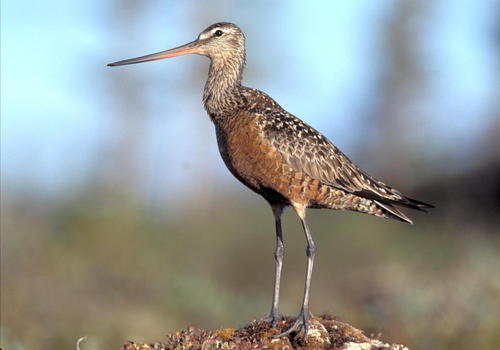
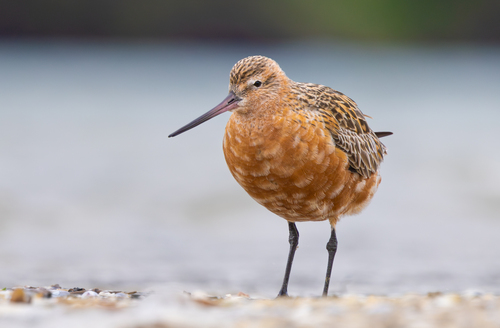
The bar-tailed godwit (Limosa lapponica) is a relatively short-legged godwit species. It measures 37–41 cm (15–16 in) from bill to tail, with a 70–80 cm (28–31 in) wingspan. Males are on average smaller than females, though there is extensive overlap in size between the sexes: males weigh 190–400 g (6.7–14.1 oz), while females weigh 260–630 g (9.2–22.2 oz). Size also varies regionally between subspecies. Adults have blue-grey legs and a long, tapering, slightly upturned two-colored bill that is pink at the base and black toward the tip. In breeding plumage, the neck, breast and belly are a solid unbroken brick red, and the upperparts are dark brown. Breeding plumage on females is much duller than on males, with a chestnut to cinnamon belly. Breeding plumage does not become fully visible until the bird’s third year, and three age classes can be distinguished. During their first northward migration, immature males are noticeably paler than more mature males. Non-breeding bar-tailed godwits found in the Southern Hemisphere are plain grey-brown with darker feather centers that create a striped appearance, and are whitish on the underparts. Juveniles resemble non-breeding adults but are overall more buff-colored, with streaked plumage on the flanks and breast. Bar-tailed godwits breeding in Alaska increase in body size from north to south within their breeding range, but this size trend does not hold on their New Zealand non-breeding grounds, where birds of different sizes mix freely. The bar-tailed godwit can be told apart from the black-tailed godwit (Limosa limosa) by its black-and-white horizontally barred tail (instead of a wholly black tail) and the absence of white wing bars; its most similar relative is the Asian dowitcher (Limnodromus semipalmatus). All bar-tailed godwits breed in the Arctic during Northern Hemisphere summer, then make a long-distance migration south to more temperate areas for winter. It has long been recognized that migrating bar-tailed godwits can fly non-stop for distances up to 5000 km. The nominate subspecies L. l. lapponica makes the shortest migrations: some travel only as far as the North Sea, while others reach as far south as India. The subspecies L. l. baueri, which nests in Alaska, travels all the way to Australia and New Zealand. This subspecies undertakes the longest recorded non-stop migrations of any bird, and to fuel these journeys, they carry the largest fat loads of any studied migratory bird, reducing the size of their digestive organs to do so. L. l. baueri breeds in Alaska and spends the non-breeding season in eastern Australia and New Zealand, while L. l. menzbieri breeds in Siberia and migrates to northern and western Australia. Siberian-breeding bar-tailed godwits travel north and south along the Asian coast, but Alaska-breeding birds migrate directly across the Pacific to reach Australasia, a distance of 11,000 km (6,835 mi). To track the return northward journey, seven birds in New Zealand were tagged with surgically implanted transmitters and tracked by satellite to the Yellow Sea in China, a distance of 9,575 km (5,950 mi); one bird flew an actual route of 11,026 km (6,851 mi) over nine days. At least three other bar-tailed godwits also reached the Yellow Sea after non-stop flights from New Zealand. One specific female from this group, flagged 'E7', continued onward from China to Alaska to breed, then departed from western Alaska in August 2007 on an eight-day non-stop flight to the Piako River near Thames, New Zealand, setting a new known flight record of 11,680 km (7,258 mi). This L. l. baueri female completed a 174-day round-trip journey of 29,280 km (18,194 mi), with 20 days spent flying. In 2021, a male bar-tailed godwit tagged 4BBRW set a new record for non-stop migratory flight with an 8,100 mile (approximately 13,035 km) flight from Alaska, USA to New South Wales, Australia; this same individual held a previous record in 2020. In 2022, a juvenile godwit flagged 'B6' left Alaska on 13 October and flew non-stop to Tasmania, marking the first time a tagged bird has taken this route. It flew a minimum of 13,560 km (8,430 mi) in 11 days 1 hour, a new record non-stop distance. To fuel these long journeys, L. l. baueri birds in New Zealand deposit much more fat relative to their body size than other subspecies, allowing them to fly distances between 6,000 km (3,728 mi) and 8,600 km (5,344 mi). Both Australasian subspecies travel north to their breeding grounds along the Asian coast to the Yalu Jiang coastal wetland in the northern Yellow Sea, the most important stopover site for bar-tailed godwits and great knots (Calidris tenuirostris) during their northern migration. L. l. baueri birds rest for around 41 days here before continuing approximately 7,000 km (4,350 mi) on to Alaska, while L. l. menzbieri spend an average of 38 days in the Yellow Sea region before flying an additional 4,100 km (2,548 mi) to the high Arctic of Russia. Bar-tailed godwits often depart early from New Zealand when winds are favorable, and appear able to predict weather patterns that will assist their entire migration route. Birds that nested in southern Alaska are larger and depart New Zealand earliest; this pattern repeats six months later, with birds departing Alaska in the same order they arrived, over the same span of days. Birds in southern New Zealand depart on average 9–11 days earlier than birds in more northern New Zealand sites. Bar-tailed godwits arrive at the Yukon-Kuskokwim Delta in Alaska in two waves: local breeders arrive in early May, and larger flocks arrive in the third week of May while en route to breeding grounds further north. In wetland habitats, bristle-worms make up the bar-tailed godwit’s main food source (up to 70% of their diet), supplemented by small bivalves and crustaceans. In wet pastures, they eat other invertebrates. At the major northern Yellow Sea staging site, they continue to hunt polychaete worms, but most of their food intake comes from the bivalve mollusc Potamocorbula laevis, which they generally swallow whole. Sexual size dimorphism leads to differences in foraging behavior between males and females, which allows for more effective exploitation of available food resources. Males are smaller than females and have shorter bills. A study at the Manawatū Estuary, New Zealand found that shorter-billed males mostly fed on small surface prey such as Potamopyrgus snails, with half of males being snail specialists, while females consumed more deeply buried prey such as worms; individual birds also showed distinct individual food preferences. Bar-tailed godwits forage actively both during the day and at night. They pick food items from the surface while walking, or probe for prey in matted vegetation by inserting their bill and twisting it. In Europe, females tend to feed in deeper water than males; males that feed in deeper water are less successful than males that feed in the tide line, while females are successful at both locations. Birds that forage in flocks have higher prey capture rates than solitary foraging birds. Individual birds also capture fewer prey when ambient temperature drops, which slows prey activity. The intensity of feeding activity depends on the tide, weather, season, and the behavior of the prey. In New Zealand, female L. l. baueri have a probing rate of 26.5 probes per 4-minute period, which is 1.6 times higher than that of males, but feeding success is similar between both sexes. The tapping foraging technique is more useful for males than for females.