About Limosa fedoa (Linnaeus, 1758)
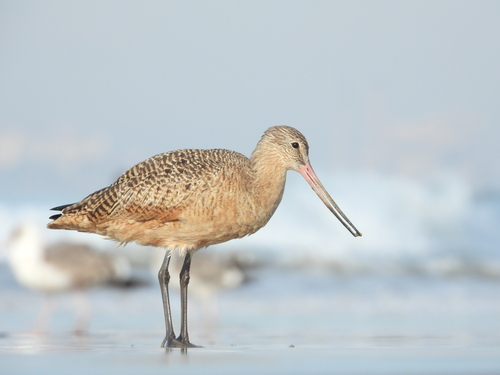
This species, Limosa fedoa, has a total length of 40–50 cm (16–20 in), including a large 8–13 cm (3.1–5.1 in) bill. Its wingspan ranges from 70–88 cm (28–35 in), and body mass varies between 240 and 520 g (8.5 to 18.3 oz). The average weight of 40 measured males was 326 g (11.5 oz), while the average weight of 45 measured females was 391 g (13.8 oz). Bill length ranges from 73.9 to 131 mm (2.91 to 5.16 in). Among all members of the sandpiper family, only curlews reach sizes that are significantly larger than this species. Adult marbled godwits have long blue-grey legs and a very long pink bill that curves slightly upward and has a dark tip. Their long neck, breast, and belly are pale brown, with dark bars on the breast and flanks. Their back is dark and mottled, and they display cinnamon-colored wing linings when in flight. Marbled godwits breed in three separate areas, each with its own unique migration route. The vast majority of the population breeds in mid-continental North America, with smaller breeding populations found in eastern Canada and the Alaska Peninsula, USA. Their largest wintering ranges are along the Atlantic, Pacific, and Gulf coasts of the United States and Mexico. Godwits that breed in western USA and Canada follow a migration route that passes through a stopover site in Utah, before reaching their final wintering sites in Mexico and the Caribbean. Individuals that breed in eastern Canada migrate across the United States, and stop at sites along the Gulf of California and Mexico. Godwits that breed in North and South Dakota winter in coastal Georgia. The Bear River Migratory Bird Refuge at Great Salt Lake, Utah, USA, is one of the most popular stopover sites for this species during both spring and fall migration. These birds forage by probing in mudflats, marshes, or on beaches. They feed when the tide is out, and may pick insects from short grass by sight. They mainly eat insects and crustaceans, and also consume parts of aquatic plants. When the tide is in, marbled godwits roost. They often sleep by standing on one leg and tucking their bill into their body.