About Limoniastrum monopetalum (L.) Boiss.
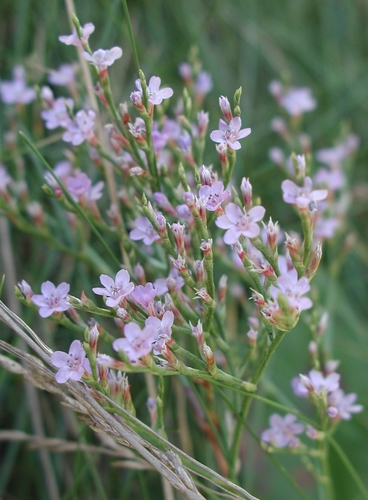
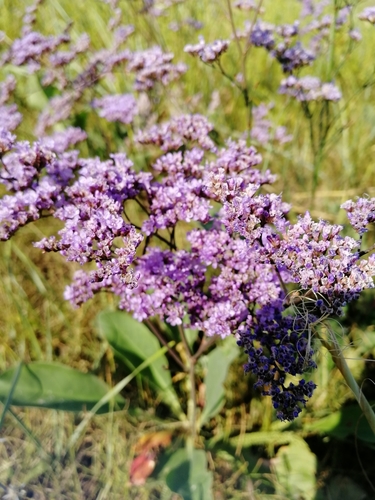
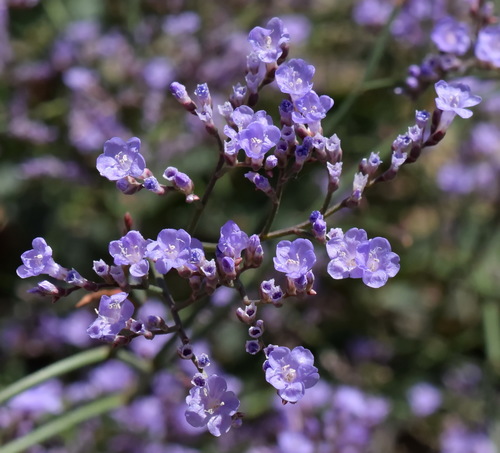
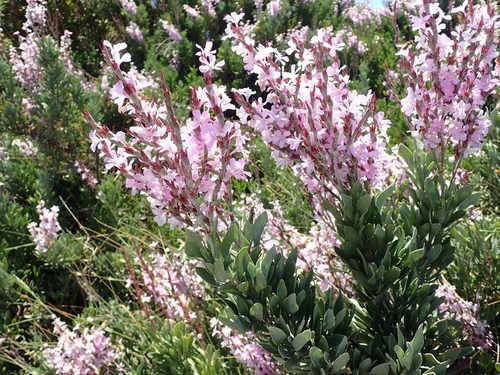
Limoniastrum monopetalum (L.) Boiss. is a small evergreen shrub. It has long, thread-like, tufted fine roots, plus ephemeral roots that grow during the wet season and then die back. Its extensive root system helps the plant tolerate high salinity, and roots can reach at least 50 cm (20 in) down to access the water table. This shrub grows 90–120 cm (35–47 in) tall, with highly branched, leafy stems that are round in cross-section (terete) and grey in colour. Leaves typically grow only on the upper sections of branches, leaving lower branch bases bare with visible leaf scars. The leaves are light green, green-grey, or silvery blue-green, stiff and leathery in texture, and narrowly spoon-shaped (spathulate). They are covered in white granulated calcareous carbonate tubercles, which give the entire plant a whitish grey appearance. Flowering occurs between mid-spring and early summer, with reported ranges from March to November, June to August, or July to August. Numerous flowers grow at the ends of branches, in shades of pink, lavender pink, purple-pink, or lavender; they fade to violet as they die. Flowers have an articulated rachis, a tubular or funnel-shaped corolla formed by petals, and leathery bracts. External sepals are 2.5–7 mm long, while internal sepals are 7.5–9 mm long, dry and membranous (scarious), and almost entirely covered by the internal bract. Each flower also has 5 stamens. After flowering, the plant produces a membranous, indehiscent fruit (seed capsule) that remains enclosed within the calyx. Limoniastrum monopetalum is native to temperate regions of Europe, Northern Africa, and Western Asia. Its native range within Europe includes Mediterranean countries: Portugal, Corsica, Spain, France, Greece, the Balearic Islands of Mallorca and Menorca, and Italy, including Sardinia and Sicily. In Northern Africa and Asia, it is native to Algeria, Libya, and Egypt. It has been introduced to Morocco and Tunisia, and has been recorded growing in the Canary Islands since 1995. In Egypt, it grows in salt marshes, coastal sand dunes, and rocky ridges; it is specifically found in salt marsh dunes around Lake Manzala and Lake Mariut on the west Mediterranean coast, and in salt marshes near Sallum. In Portugal, it grows in salt marshes alongside Atriplex portulacoides, and often grows alone in its habitat. L. monopetalum is hardy to Mediterranean climates, and can withstand occasional frosts down to −5 °C (23 °F), which corresponds to USDA Hardiness Zones 10a to 11. It can grow in any soil type, including poor and salty soils, and grows particularly well in sandy soils. It tolerates neutral or acidic soils with pH levels between 6.6 and 7.8. It prefers full sun positions, and is highly resistant to drought and pollution. It is well-suited for coastal planting, and is used in Mediterranean coastal gardens for slope coverage, planted in bushy groups, and grown in pots and planters. It pairs well with plants from the genera Cistus, Salvia, Rosmarinus, Eriocephalus, and Bupleurum. In the Balearic Islands, it has been grown as a groundcover for motorway roadsides, and has become naturalized in some near-shore (littoral) areas. It is not usually affected by common Mediterranean pests and diseases. Limoniastrum monopetalum is a traditional medicinal plant; infusions made from its leaves have anti-dysenteric properties that act against infectious diseases. Both L. monopetalum and Limoniastrum guyonianum have been studied for antioxidant activity. It is used as fodder for camels, especially during winter, and is used as a fuel source on farms. This shrub provides an ecological habitat for many insect species, including Lepidoptera and Hymenoptera such as Oecocecis guyonella and Acalyptris limoniastri; the insect larvae feed on the plant and create galls on branches where they pupate. In southern Tunisia, these galls are used for tanning leather and dyeing hair. Infusions made from both the galls and leaves are used medicinally to treat infectious or parasitic diseases that cause diarrhoea. L. monopetalum has potential use for xeriscaping and landscape architecture in semi-arid Mediterranean areas, especially in poor, saline, neglected, or degraded soils. It also provides ecological benefits as a sand accumulator via its root system, and acts as a salt-tolerant windbreak.