About Limnoperna fortunei (Dunker, 1857)
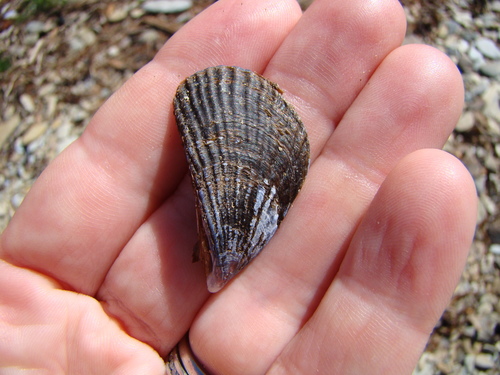
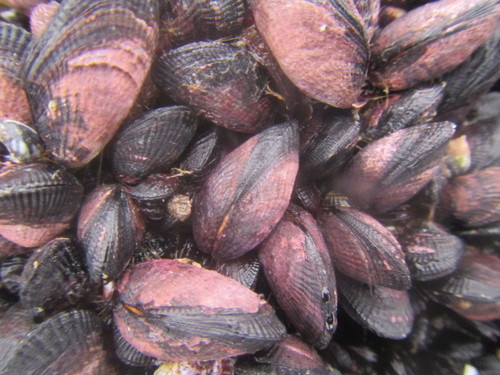
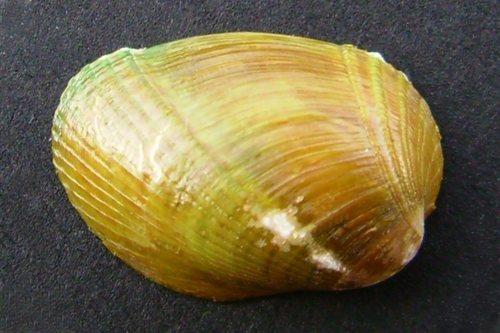
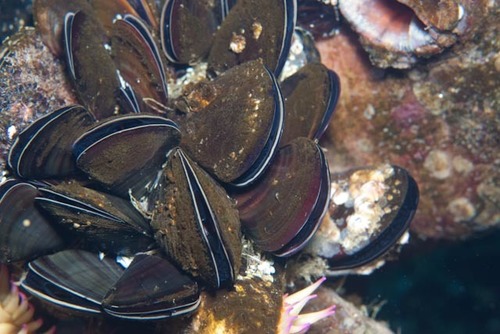
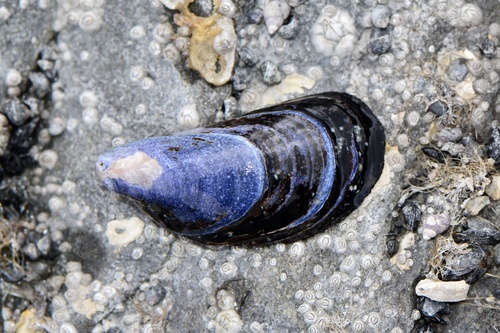
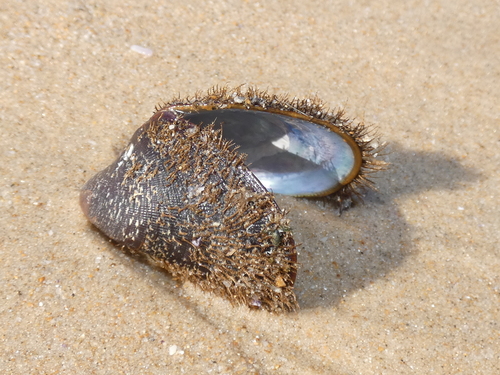
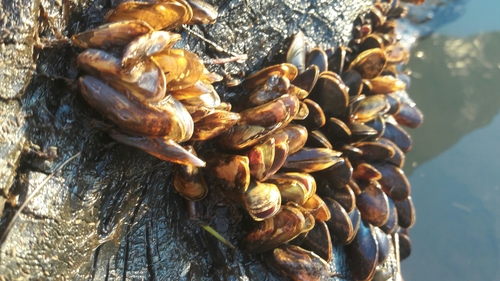
Limnoperna fortunei (Dunker, 1857), commonly called the golden mussel, has small larvae around 100 micrometres (1⁄250 in) that live in the water column until they are ready to settle. Adult golden mussels are usually 20–30 millimetres (3⁄4–1+1⁄4 in) long, though specimens over 45 millimetres (1+3⁄4 in) have been recorded. The outer shell surface ranges from golden to dark brown, while the inner shell is nacreous, with a color from pearly white to purple. The shell valves are very thin and brittle, and have no hinge teeth. The mantle is fused on the dorsal side, and also between the exhalant siphon and the inhalant aperture. Water enters the mussel's mantle cavity through the inhalant aperture. After moving through the cavity, suspended particles are filtered out; usable particles are ingested and digested in the gut, with undigested remains egested as feces, while unwanted particles are discarded as pseudofeces. Filtered water is expelled through the exhalant siphon. These water currents also support respiration and the removal of excretory waste products. The mussel attaches to hard substrates using byssal threads, and forms dense beds of closely packed individuals. Internally, a set of muscles attached to the valves control valve closure, byssus retraction, and foot movement. The golden mussel's native range is most likely the Pearl River basin in southern China, with long-established populations in China, Thailand, Korea, Laos, Cambodia, Vietnam, and Indonesia. Its presence in Laos, Cambodia, Thailand and Vietnam is probably the result of historical human migrations. Between 1965 and 1990, it spread to Hong Kong, Korea (where it may be native), Taiwan and Japan. Shortly after this period, it reached South America: it appeared in Argentina around 1990, and by 2006 had spread to Uruguay, Paraguay, Bolivia, and Brazil. As of 2017, it occupied two major South American basins: the Río de la Plata basin (including the Paraguay-Paraná and Uruguay rivers) and the São Francisco basin, plus several smaller South American watersheds: Mar Chiquita, Guaíba, Patos-Mirim, and Tramandaí. Further northward spread into the Amazon, Orinoco, and Magdalena basins of South America, and into Central and southern North America, is considered very likely. The first confirmed occurrence of this species in North America was announced in October 2024, found in the Sacramento–San Joaquin River Delta at the Port of Stockton, California. L. fortunei arrived in Hong Kong as veligers from a Pearl River tributary in the late 1960s. Within two to three years, it had colonized local water supply infrastructure and some natural water bodies, and has since increased in density and recolonized Hong Kong's water supply systems annually. Limnoperna fortunei is dioecious, with approximately equal numbers of males and females, and only very small proportions of hermaphrodites. Individuals reach sexual maturity early, when they are about 5–6 millimetres (13⁄64–15⁄64 in) long. Ova and sperm are released into the water, most likely at the same time in the same area, where fertilization occurs. Fertilized eggs develop into a series of planktonic life stages, including a trochophore and a veliger around 150 micrometres in size. The final larval stage before settling on a substrate is the plantigrade larva, which measures ~250 micrometres (1⁄64 in). This stage takes between 20 days at 20 °C (68 °F) and 12 days at 28 °C (82 °F) to develop. The reproductive cycle, described for both Asian and South American populations, is clearly tied to water temperature. In South America, when water temperatures are between ~10 and 30 °C (50 and 86 °F), larvae are produced continuously for 6–10 months each year between spring and autumn, often with clear peaks around November and April. In Japan, where water temperatures are around 5–20 °C (41–68 °F), larval production is limited to 1–2 summer months. Larval densities during the reproductive season vary widely, but normally average around 6000 larvae per cubic meter of water, though densities over 20000 larvae per cubic meter have been reported. In water bodies with strong cyanobacterial blooms, reproduction can be completely suppressed, because cyanobacterial microcystin toxins cause massive larval death. The golden mussel has a lifespan of around 2 years. Growth is fastest during the summer, and drops sharply in winter. During their first year, mussels typically grow to ~20 millimetres (25⁄32 in), and reach ~25–30 millimetres (63⁄64–1+3⁄16 in) by the end of their second year. Growth rates and final adult size depend mostly on water temperature and the time of year an individual is born, though calcium concentrations, pollution, food availability and intraspecific competition also play important roles. L. fortunei is one of several biofouling pests that should be a high quarantine priority globally. L. fortunei is a strictly freshwater species, though it can tolerate brackish water with up to 23 grams of salt per liter for short periods of just a few hours. The mussel requires hard substrates for settling, such as rocks, wood, floating and submerged plants, mussel shells, and crustaceans. While it cannot survive on fine loose sediments, it occasionally colonizes muddy areas that have been stabilized by roots or fibrous debris. Because most water body colonies are heavily preyed on, mostly by fish, colonization is often limited to crevices that large predators cannot access. Mussel beds can cover extensive areas, with densities often exceeding 200,000 individuals per square metre (over 800 million per acre), including early juveniles less than 1 millimetre (3⁄64 in) in size. However, these beds rarely exceed 7–10 centimetres (3–4 in) in thickness, and most adults are at least partially attached directly to the underlying substrate. New juvenile recruits settle more often in established mussel beds than in other locations; juveniles often attach to the shells of larger adult mussels, but eventually move deeper toward the base of the bed. Very few large-scale surveys of population density have recorded around 1000 mussels per square meter. In lakes, reservoirs and rivers, mussel colonization is usually limited to coastal areas, where hard substrates are more abundant, because loose sediments are carried away from these higher-energy zones into deeper water. The golden mussel is a filter-feeder. Adult individuals process around 1 liter of water every 10 hours, retaining organic particles including phytoplankton and zooplankton. Unwanted materials are egested or rejected in mucous strands that settle to the bottom. This filtering process changes the water column by reducing suspended particles and water column primary production, and increasing water transparency, which in turn encourages the growth of submerged macrophytes. Additionally, nutrient concentrations of ammonia, nitrate, and phosphate in the water increase, which favors the growth of often toxic cyanobacteria. Bottom deposits and sediments retained among mussels are enriched with organic matter. Benthic organisms and detritus-feeding organisms in general, including many fish species, benefit from this additional energy source. In particular, benthic invertebrates are usually more diverse and abundant in mussel beds than in other habitats. In South America, adult L. fortunei is preyed on by at least 50 fish species. The introduction of this mussel to South America has been tentatively linked to large increases in landings of Prochilodus lineatus, the most commercially important detritivorous fish species in the Río de la Plata basin. In Argentina and Japan, over 90% of the mussel's total production is lost to predation, most presumably from fish, but also likely from other invertebrates, waterfowl, turtles, and mammals. In South America, planktonic golden mussel larvae are actively eaten by the larvae of around 20 fish species, especially from the orders Characiformes and Siluriformes. This larval diet has been shown to significantly improve fish growth, particularly during the earliest developmental stages. Evidence for whether golden mussel impacts on invaded ecosystems are positive or negative is mixed and debated. This issue is further complicated because the same change can produce opposite results. For example, while organic matter from the mussel's feces and pseudofeces, plus protection from mussel colonies, can increase the abundance and diversity of benthic invertebrates, the additional organic matter can also deplete oxygen levels near the bottom, which reduces the abundance and diversity of benthic invertebrates.