About Limnodromus scolopaceus (Say, 1822)
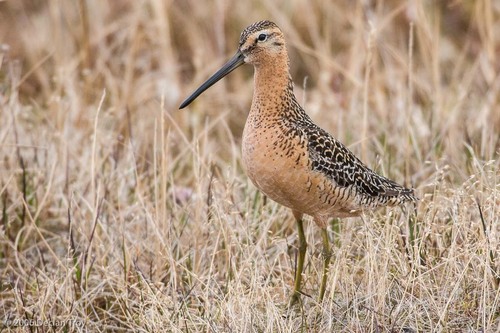
The long-billed dowitcher, scientifically named *Limnodromus scolopaceus* (Say, 1822), is a medium-sized, stocky sandpiper. Its bill is roughly twice as long as its head. Across all plumage types, it has a whitish supercilium (eyebrow stripe) and a dark loral stripe that runs continuously past the eye. Its tail is barred black and white, with black bars nearly twice as wide as the white bars, and it has a large, distinctive white rump that extends up to the middle of its back.
Breeding plumage occurs from approximately May to late August or early September. In fresh breeding plumage, adults have a dark crown, and rufous (reddish-brown) neck, chest, and belly, with black bars across the breast and white barring on the flanks. As feathers age, the black bars fade, leaving the breast a darker reddish shade. The crown and back are a mix of brown, black, and buff markings, while the wings and upper back are mottled with black, buff, and white markings, giving an overall dark brown appearance.
In non-breeding (winter) plumage, long-billed dowitchers are very hard to tell apart from short-billed dowitchers in the field. Non-breeding adults are dull gray, with darker upperparts and breast that contrast with a paler white belly; the gray color of the breast gradually lightens as it approaches the chin.
Juvenile plumage is similar to that of breeding adults, but paler overall. Juveniles can be distinguished from juvenile short-billed dowitchers by their tertiary feathers: on long-billed dowitchers, these feathers are dark gray with narrow buff edges, and their internal markings are so dull that they appear to be absent entirely. Juveniles have upper part feather fringes that are chestnut rather than buffy brown, and their uniformly gray breast is slightly demarcated from the pale rufous lower belly. The bill of the long-billed dowitcher ranges from 62 mm to 72 mm; males tend to have smaller bills matching their overall smaller body size. Bills are typically very straight and black, turning yellowish olive-green near the base, and the legs are also yellowish. The sexes are almost identical, though females are generally heavier, and have longer wings and longer bills. Standard measurements are: length 11.4 inches (29 cm), weight 3.1–4.6 ounces (88–130 g), wingspan 18.5–19.3 inches (47–49 cm).
For reproduction, male long-billed dowitchers court females by first singing to them, then competing with other males by pursuing the female in flight, displaying an aerial show of speed and agility. After mating, males are known to sing while hovering 15 feet in the air above their territories. Pairs are generally monogamous for a single breeding season, and do not stay paired across multiple years. Long-billed dowitchers nest in wet areas with tall grasses, in the troughs between raised mounds and ridges. The nest is a simple ground depression, usually lined with grass and leaves. The average clutch size is four eggs per brood. The eggs are oval to pear-shaped, and range in color from buff olive to greenish or blueish glaucous. They are heavily splotched with varying shades of brown near the large end, with underlying dark gray markings. Incubation lasts approximately twenty days, and both sexes participate. Long-billed dowitcher chicks are precocial and downy, able to feed themselves within a few hours of hatching; the male parent cares for the chicks until they fledge.