About Limnaecia phragmitella Stainton, 1851
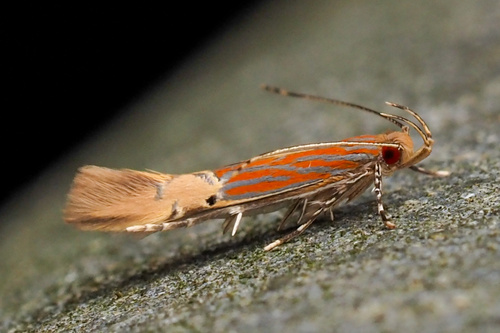
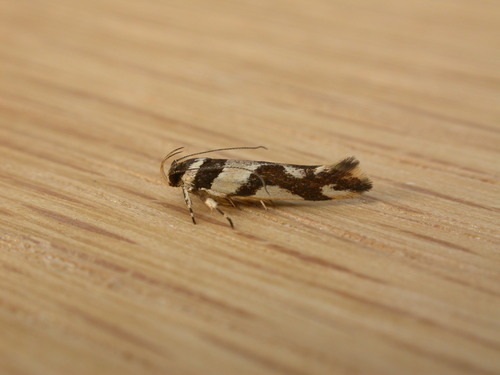
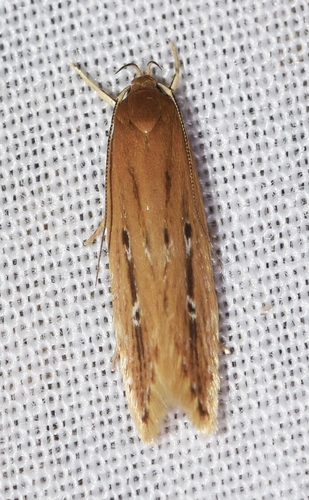
The shy cosmet moth, Limnaecia phragmitella, is a moth species in the family Cosmopterigidae. This moth has been recorded across all of Europe, Asia, Australia, and New Zealand. It is also found in North America, where its distribution ranges from Nova Scotia to Virginia, extending west to Oklahoma and north to Ontario. Its preferred habitat is fens and marshes. Adult moths measure between approximately 15–22 mm (0.59–0.87 in) in size. The head is ochre-colored, while the antennae are yellowish white with brown rings and an almost white area at the apex. The thorax and tegulae are ochre. The forewings are primarily ochre, and pale yellow along the costa. An indistinct grey-brown line follows the anal fold, with an elongated white spot located in front of the line's distal end. In the center of the forewings, there are two grey-brown spots edged in white. The inner spot sits before the half-length point of the forewing, and the outer spot sits at the three-quarter length point of the forewing. Both spots are connected by a grey-brown line that starts as a narrow line just behind the base of the wing. In the apical area, the wing veins are grey-brown, and are occasionally outlined in white. A row of whitish dots runs along the apex of the wing. The fringed scales are pale ochre, and grow more yellowish toward the wing's inner edge. The hindwings are grey, and the abdomen is brownish grey, with yellowish white bands on the back of each segment. In male individuals of this species, the brachia are extremely asymmetrical. The right brachium is long, pointed, strongly sclerotized, and measures 2.5 times the length of the left brachium. The valves are concave, with a short, rounded cucullus. The right valve is wider at its base. The valvellae are also strongly asymmetrical. The left valvella is spatula-shaped and longer than the valve, with a patch of short needles at its tip. The right valvella is short, curved, strongly sclerotized, and fused to the right valve. The aedeagus is short, tapering toward its tip, with a bulbous proximal section. In female individuals, the anal papillae are fused and only slightly sclerotized. The apophyses are very long, strong, and strongly sclerotized. The sterigma is tubular, slightly curved, and sclerotized. The ductus bursae tapers slightly toward the corpus bursae, with its distal half sclerotized. The corpus bursae is ovate, and bears two signa covered in short needles. Adult moths are active on the wing during July in western Europe, and from June to August in North America.