About Limax maximus Linnaeus, 1758
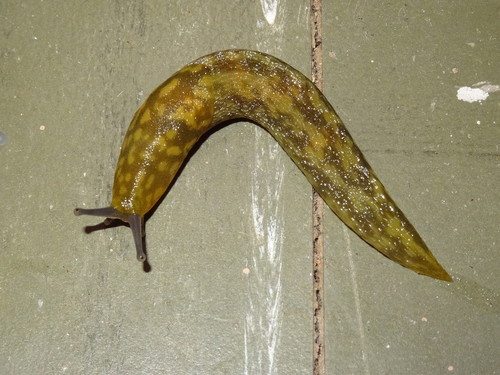
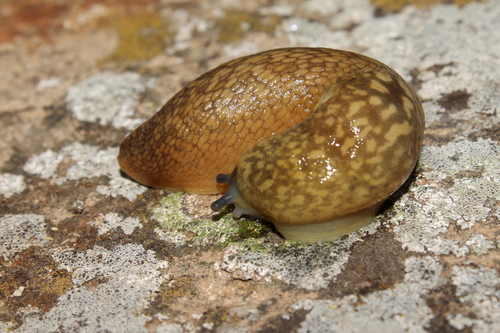
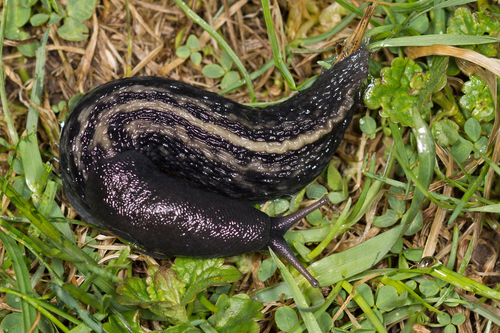
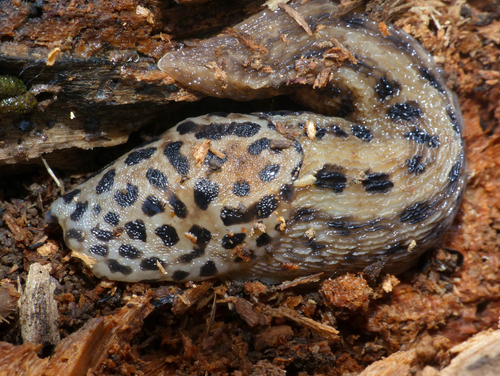
Limax maximus (literally meaning "biggest slug"), with common names great grey slug and leopard slug, is a keeled slug species in the family Limacidae. It is among the largest keeled slugs, while Limax cinereoniger is the largest. Limax maximus is the type species of the genus Limax. Adult individuals measure 10–20 cm (3.9–7.9 in) in length, and are generally light grey or grey-brown with darker spots and blotches; the species' body coloration and exact patterning is quite variable. This species has a very unusual and distinctive mating method: pairs of slugs hang suspended in air from a tree branch or other structure using a thick thread of mucus. Although native to Europe, this species has been accidentally introduced to many other parts of the world. It was first recorded outside its native range in Philadelphia, USA in 1867.
Fossil distribution of Limax maximus cannot be confirmed, because internal shells of different Limacidae species are not distinguishable at the species level, so the fossil range of Limax maximus and other Limacidae species is unknown. Unidentified calcitic Limacidae shells are known from European Tertiary and Quaternary deposits.
This species is now widely distributed globally, and is generally accepted to be native to Europe and Mediterranean African countries. Indigenous distribution includes: in Western Europe: Great Britain, Ireland, Belgium, Netherlands, Luxembourg, France, Germany, Italy, Switzerland, Spain, Portugal; in Eastern Europe: Albania, Bosnia-Hercegovina, Bulgaria, Croatia, Greece, Serbia; in Africa: Egypt, Algeria, Morocco.
The non-indigenous distribution of Limax maximus covers many countries worldwide: all remaining European countries not listed above; in Africa: Mozambique, South Africa; in North America: Canada (present in 5 of 10 provinces), Mexico, United States (present in 46 of 50 states); in South America: Argentina, Brazil, Chile, Colombia; in Asia: China, Japan, India; in Oceania: Australia, New Zealand.
This slug is almost always found near human settlements, most commonly in lawns, gardens, cellars and other damp areas. It is not a gregarious species. It frequents gardens, damp, shady hedgerows and woods, hiding during the day beneath stones, under fallen trees, or in other obscure, damp spots. It shows a clear preference for areas near human habitations, and readily settles in damp cellars or outbuildings. In Ireland, the species does not show this preference for human dwellings, and is restricted to woods and other similar habitats. It can even be found almost within the high-water mark on seashores.
In its life cycle, this slug's eggs are deposited in clusters, and are slightly attached to one another. The eggs are transparent, elastic and slightly yellowish, and measure 6×4.5 mm. They hatch after approximately one month. The newly hatched tiny slugs require at least two years to reach sexual maturity. The total lifespan of Limax maximus is 2.5–3 years.