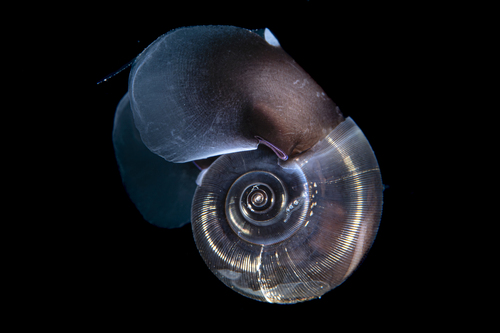
About Limacina helicina (Phipps, 1774)
Limacina helicina (Phipps, 1774) is a species of pteropod, and like all pteropods, its wing-like parapodia evolved from the original gastropod foot. The soft body of this species is dark purple or violet, with paler, translucent parapodia. Its shell is sinistral, subglobose, subdiscoidal, hyaline, and very thin. The spire is depressed, though it is relatively taller compared to spires of other species in the genus Limacina. The shell has a wide umbilicus, and its aperture is taller than it is wide. The shell is made up of 5 to 6 transversely striated whorls with a distinct suture. The final whorl is large, with a very faint keel adjacent to the umbilicus. The shell width ranges from 5 to 10 mm, and can reach up to 13 mm; the shell height reaches a maximum of 6 mm when the maximum width is 8 mm. Adult members of the genus Limacina typically no longer retain an operculum. The radula of Limacina helicina consists of 10 rows, each containing one central tooth and two lateral teeth. Its digestive system includes an esophagus, gizzard sac, and gut. The type locality of Limacina helicina is the Arctic seas, and it is the only thecosome pteropod found in Arctic waters. Its overall distribution is limited to arctic and subarctic (subpolar–polar) waters, particularly the Arctic Ocean, with recorded occurrences including: the Northern Atlantic Ocean between 50°N and 60°N, the Norwegian Sea, the Faroe Islands, north of Iceland, Spitsbergen, the Denmark Strait and Davis Strait off Greenland, Anticosti Island, the Laurentian Channel, the Magdalen Islands, Prince Edward Island, Newfoundland, and the Strait of Belle Isle in Canada, the area between Cape Hatteras (North Carolina, USA) and Newfoundland, and the area from the Gulf of Alaska to Friday Harbor, Washington in the USA, the White Sea, Novaya Zemlya, the Sea of Okhotsk, the Sea of Japan, the Bering Sea, the Chukchi Sea, the Kurile Islands, and the Commander Islands in Russia, and waters off Kasumi, Hyōgo in Japan. All pteropods are strictly pelagic mollusks highly adapted to life in the open ocean, and actively swim in the water column. Limacina helicina is a holoplanktonic species that inhabits upper epipelagic and glacial waters. It lives in water temperatures ranging from -0.4 °C to +4.0 °C, and rarely occurs in waters up to 7 °C. Its vertical distribution is influenced by body size and other factors. Individuals between 0.2 and 0.4 mm in size live mainly at depths from 0 m to 50 m, while larger individuals live from 0 m to 150 m. A 1991 study by Gilmer & Harbison found larger Limacina helicina occur mainly at depths of 5–25 m, with abundances reaching up to 2.5 adults per cubic meter. They are rarely found in the upper 4 m of the water column, likely due to turbulence. As early as 1774, Constantine John Phipps noted that Limacina helicina occurred in "innumerable quantities" in arctic seas. It is a major component of polar zooplankton, and can make up more than 50% of total zooplankton abundance (individuals per unit volume). Species in the clade Thecosomata produce a fragile external calcium carbonate shell, which may act as ballast to enable large vertical migrations and as protection against predators. The shell of thecosomes is made of aragonite, which makes it very sensitive to dissolution; aragonite is a metastable form of calcium carbonate, and is more soluble in seawater than calcite. Due to its highly soluble aragonite shell and polar distribution, Limacina helicina may be one of the first organisms affected by ocean acidification, and is therefore a key indicator species for this process. As a key indicator of ocean acidification and a major component of polar ecosystems, Limacina helicina has become a focus of acidification research. Laboratory experiments show the species is able to precipitate calcium carbonate at low aragonite saturation states, and appears to be relatively more resilient to elevated carbon dioxide (CO2) concentrations than other aragonite-producing organisms such as corals. Even so, experimental results support existing concerns for the future of Arctic pteropods, because their shell production appears to be highly sensitive to decreased pH. A decline in Limacina helicina populations would likely cause dramatic changes to multiple pelagic ecosystems. However, Limacina helicina shows high transcriptomic plasticity in response to acute abiotic stress, which suggests this species may have a limited ability to acclimate to the effects of ocean acidification and ocean warming. Shelled pteropods also play a geochemical role in the ocean carbon cycle: they contribute to calcium carbonate export, and can make up a major component of carbon transport to the deep ocean. In 2011, researchers found 24–53% of Limacina helicina individuals off the U.S. West Coast had shells damaged by dissolution. Limacina helicina is a protandric hermaphrodite. Males are smaller, reaching 4–5 mm in size, before changing sex to become females, which grow larger than 5 mm. Sperm is transferred via spermatophores during copulation. The species lays eggs in ribbon-like clusters, mainly in summer, with smaller egg-laying activity also occurring in winter. Veliger larvae are about 0.15 mm in size. Gonads can be detected in individuals once they reach 0.7 mm in size, and fully mature individuals are 0.8 mm in size. The full life cycle of Limacina helicina lasts approximately 1 to 2 years.

