About Limacia cockerelli (MacFarland, 1905)
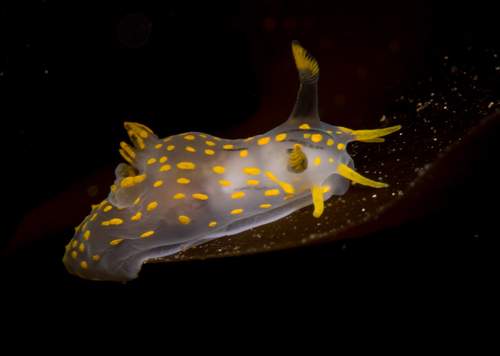
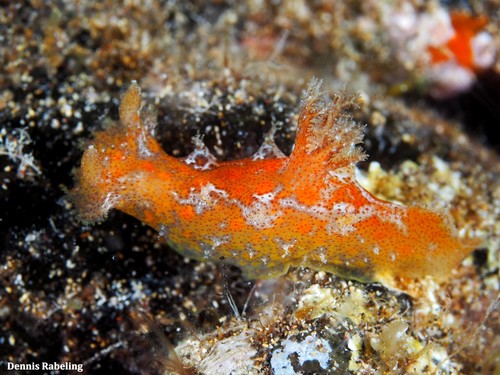
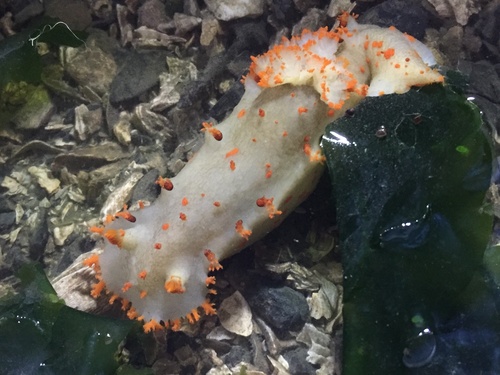
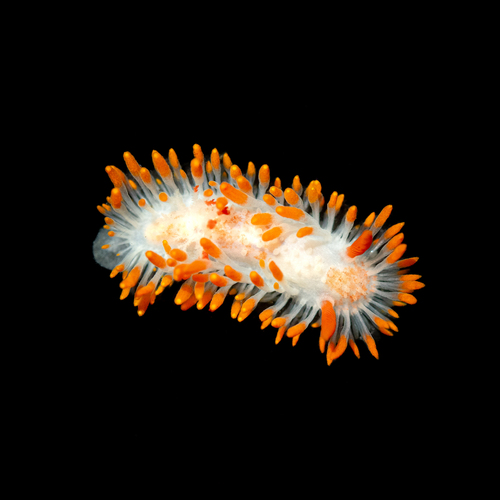
This species reaches a maximum length of 26 millimeters, or 1.0 inch. It has long dorsal papillae with orange-red tips, and white branchial plumes that have red tips. A broad band of white tubercles runs down the center of its dorsum; these tubercles may sometimes have a small orange spot at their apex. A second form of this species, found in regions south of Point Conception, has slightly longer tubercles along the mid-dorsal line, all tipped with orange. A third form found in California has large red blotches on its dorsum. The eggs of Limacia cockerelli are pink. When kept at temperatures between 10–13 °C, or 50–55 °F, these eggs develop and hatch after 17 days into planktotrophic veligers. It was previously considered likely that the southern form was part of a species complex, and this was confirmed in 2017 when the species Limacia mcdonaldi was formally described. Limacia cockerelli occurs along the west coast of North America, with a range extending from Vancouver Island, British Columbia, Canada down to San Diego, California. It was once reported from Bahía de los Ángeles in the Gulf of California, but these records are now recognized to actually represent the closely related species Limacia mcdonaldi.