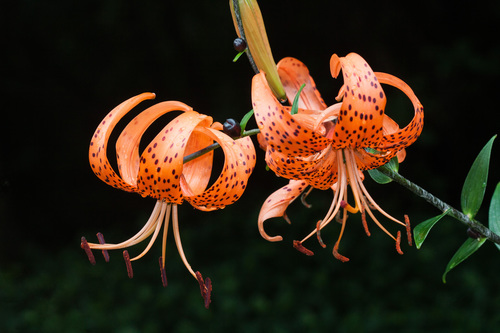
About Lilium lancifolium Thunb.
Like other true lilies, Lilium lancifolium Thunb. grows on upright stems 80–200 centimetres (31–79 inches) tall. These stems bear lanceolate leaves that are 6–10 cm (2+1⁄2–4 in) long and 1–2 cm (3⁄8–3⁄4 in) broad. L. lancifolium produces small aerial bulblets called bulbils in its leaf axils; bulbils are uncommon among Lilium species, and they grow into new plants that are clones of the original parent plant. The species’ flowers are odorless, each lasting only a few days. If pollinated, flowers produce capsules that hold many thin seeds. Extrafloral nectaries on this species were first recorded by Zimmerman in 1932.
These lilies can reproduce through both sexual and asexual reproduction, and their reproductive ability depends on their cytotype. Some populations are diploid, with two copies of their chromosomes, while other populations are triploid, with three copies of their chromosomes. Most North American populations of Lilium lancifolium are triploid, while Asian populations can be either diploid or triploid. Diploid populations are able to use both sexual and asexual reproduction. Triploid populations are sterile, however, and can only reproduce asexually, primarily by forming bulbils in the leaf axils.
A 2007 case study published successful treatment of a cat that had ingested this species. In Asia, the plant’s bulbs are cultivated and wild-harvested for use as food. The cultivar 'Splendens' has received the Royal Horticultural Society's Award of Garden Merit. In Taiwan, both the flowers and bulbs of this lily are eaten, along with the flowers and bulbs of three related species: L. brownii var. viridulum, L. pumilum, and L. candidum.