About Lilium iridollae M.G.Henry
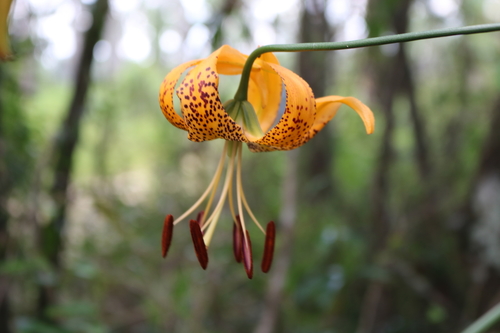
The flower stalk of Lilium iridollae can reach up to 6 feet tall, though most grow between 4 and 5 feet tall. Each individual stalk produces only one solitary flower that hangs downward from the stem. Each flower measures roughly 3 to 4 inches wide, with color ranging from pale yellow to deep orange. The flower petals are recurved, so they touch each other behind the stem, while the stamens and stigma hang downward into the open space. The petals also have prominent brownish-black spots, and the flowers have no fragrance. Lilium iridollae grows along streams in wet pine woodlands and pitcher plant bogs in the southeastern United States, and occurs mainly in Florida, North Carolina, South Carolina, Alabama, and Virginia. This species is classified as endangered in Florida and threatened in North Carolina. The habitat balance of this plant depends on periodic naturally occurring lightning-caused fires. These fires reduce competition from other plants, and release nutrients and organic matter from burned peat moss and leaves into the region’s acidic, nutrient-poor soil. Lilium iridollae is sensitive to changes in drainage patterns and water quality, which makes it highly vulnerable to ecosystem disturbances, such as overgrazing by livestock and nearby urban development. Like many of its close relatives, Lilium iridollae is pollinated mostly by large swallowtail butterflies. It is also attractive to bees and birds. After successful pollination, a large seed capsule develops that can hold many hundreds of seeds. Lilium iridollae is deciduous, and returns to a dormant bulb stage in late fall. In early spring, new leaves emerge and immediately form a basal rosette. The rosette begins to elongate in late spring, and flowering starts in mid to late July. Its seeds are light brown, and exhibit delayed hypogeal germination without stratification over 1 to 2 months. If growing conditions are not suitable, native Lilium iridollae individuals often fail to flower, and may appear only as a basal leaf rosette each spring for multiple years. Even under optimal conditions, young plants grown from seed mature slowly, taking more than two years to reach flowering stage. Lilium iridollae requires very specific growing conditions, which makes it an elusive species for many gardening enthusiasts. The southeastern United States is generally not considered good for growing garden lilies, because its warm winter temperatures and high humidity do not suit most garden lilies.