About Lilium concolor Salisb.
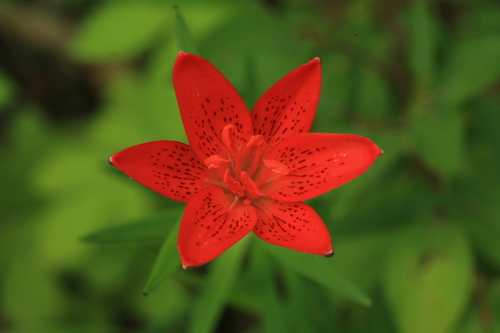
Lilium concolor Salisb. is a perennial lily that grows at altitudes between 350 and 2000 meters above sea level. It is a stem-rooting species, meaning it produces adventitious roots above its bulb and along its stems. Its stems are terete (cylindrical), nearly glabrous, smooth, and reddish-green in color; purple pigmentation is present near the stem base. Stems typically grow 30–50 cm tall, and each stem bears 1 to 5 flowers. Its green leaves are scattered, linear to lance-shaped, with sparse hairs along the margins and underside; leaves are generally 3.5–7 cm long and 3–6 mm wide. This species has an ovoid (egg-shaped) bulb that measures 2–3.5 cm in both height and diameter, and the bulb is smaller than that of Lilium brownii. A single bulb can grow and flower for several years. The flowers of Lilium concolor are showy, star-shaped, and glossy, with a color range from orange-yellow to scarlet; pure yellow flowers occur rarely. All flowers face upward, and they can grow in clusters of up to 10 flowers, arranged in either a raceme or umbel form. Flowers have an unpleasant scent and are ephemeral, with each individual flower lasting only a few days. Flowers are hermaphrodite, pollinated by bees, and produce small seeds. The tepals are spotted, oblanceolate, and slightly woolly on the outside, measuring 3–4 cm long. The style is shorter than the ovary; stamens tend to converge toward the center, and match the color of the tepals. The stigma is slightly swollen, and sits above the cylindrical ovary. Perianth segments are 2.2–3.5 cm long. Lilium concolor is native to East Asia, and is particularly widespread across China. It grows in 11 Chinese provinces: Inner Mongolia, Heilongjiang, Jilin, Liaoning, Hebei, Shanxi, Shaanxi, Henan, Shandong, western Hubei, and is rarely found in northeast Yunnan. It has a larger distribution range than other lily species native to these regions. In northern China, it grows on grassy mountain slopes, scrubs on rocky slopes, forest clearings, or woodland edges. It grows in large numbers on ridges north of the summit of Tai Shan in Shandong province at 1532 meters altitude, especially in open grassy areas. It is also found scattered among low bushes of Rhododendron micranthum and Spiraea pubescens. Beyond China, the species also occurs in Japan, Korea, and eastern Russia, including Amur Krai, Primorye, Khabarovsk, and Zabaykalsky Krai. Additional habitats for the species include heavy limey soil, humus on carboniferous limestone, grassy slopes, sunny grasslands, and moist areas within forests, thickets, and meadows. Lilium concolor is cultivated in Japan as a food plant. Its flowers, leaves, bulbs, and roots are all edible. The bulb is sweet and cooling, contains starch, and can be cooked and eaten as a vegetable similar to potatoes, or processed to make wine. In medicine, the bulb has carminative, expectorant, sedative, antitussive, pectoral, and tonic properties. It is used to treat bronchial issues, uterine fluxes, choreic affections, ulcers, and swellings. The flowers invigorate the blood, and are used as a poultice to cure sores, boils, and foul ulcers.