About Ligustrum vulgare L.
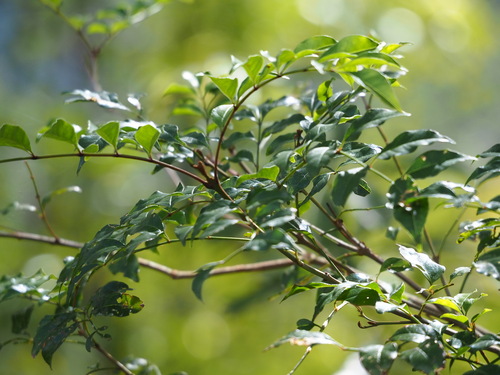
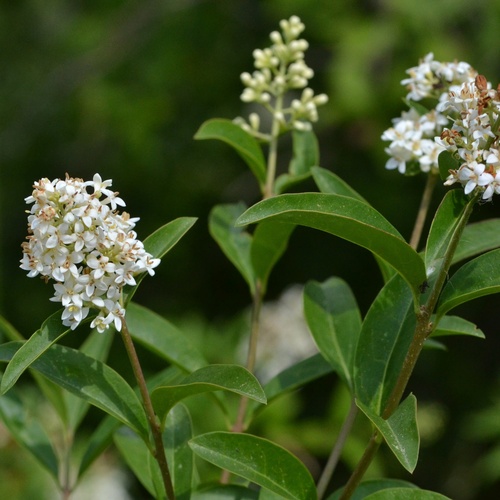
Ligustrum vulgare L. is a semi-evergreen or deciduous shrub that reaches a height of 3 m, and rarely grows up to 5 m. It has stiff, erect stems with grey-brown bark marked by small brown lenticels. Its leaves grow in decussate opposite pairs, are sub-shiny green, and shaped from narrow oval to lanceolate. They measure 2–6 cm long and 0.5–1.5 cm broad. Flowers develop in mid-summer in 3–6 cm long panicles. Each flower is creamy-white, with a tubular base and a four-lobed corolla (petals) that is 4–6 mm in diameter. The flowers emit a strong, pungent fragrance that many people find unpleasant. The fruit is a small glossy black berry 6–8 mm across, holding 1 to 4 seeds. The berries are poisonous to humans, but are readily eaten by thrushes, which disperse the seeds via their droppings. Plants from warmer regions within the species' range are more likely to be fully evergreen; these have sometimes been classified as a separate variety, Ligustrum vulgare var. italicum (Mill.) Vahl, though other botanists do not recognize this variety as distinct. In the British Isles, it is the only native privet. It is common in hedgerows and woodlands of southern England and Wales, especially on chalk areas. It is less common in northern England, Scotland, and Northern Ireland, where it only grows as an escapee from cultivation. This species was used for hedging in English Elizabethan gardens, but was later replaced by the more consistently evergreen introduced species L. ovalifolium from Japan. A number of cultivars have been selected for cultivation: 'Aureum' has yellow leaves; 'Buxifolium' has small, oval leaves that do not exceed 2.5 cm long; 'Cheyenne' is a cold-tolerant clone selected in North America; 'Chlorocarpum' produces green berries; 'Insulense' has long, narrow leaves 5–11 cm long and 1-2.5 cm broad; 'Leucocarpum' bears greenish-white berries; 'Lodense' is a dense, dwarf shrub, its name is a portmanteau of 'low' and 'dense'; 'Pyramidale' is fastigiate; 'Xanthocarpum' has yellow berries.