About Ligustrum ovalifolium Hassk.
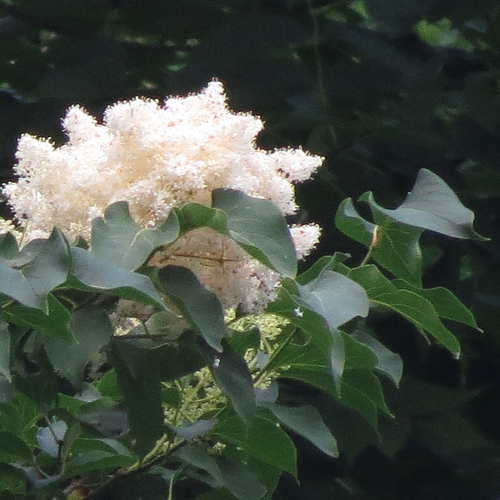
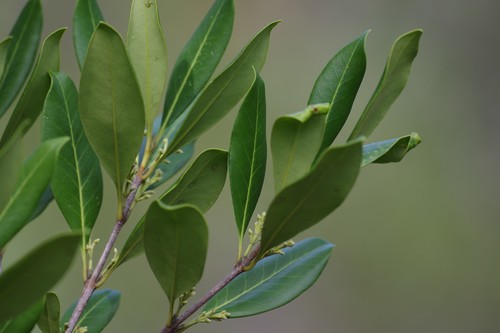
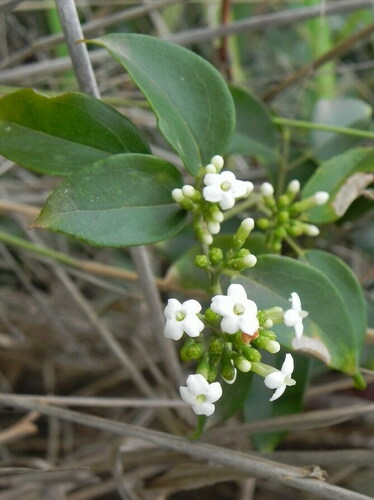
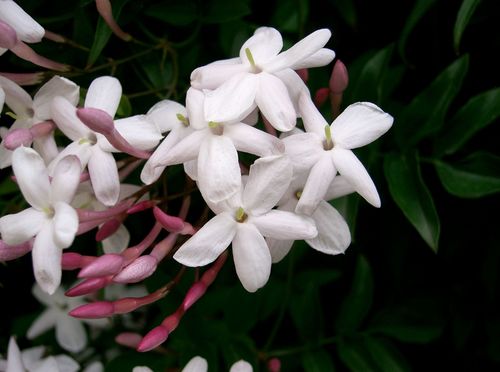
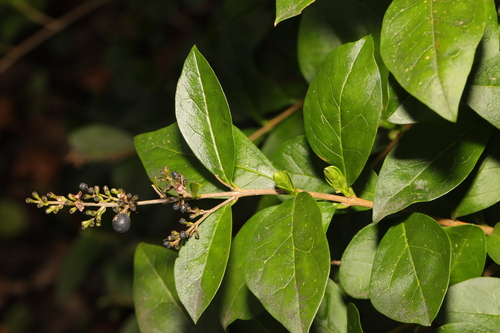
Ligustrum ovalifolium Hassk. is a dense, fast-growing deciduous shrub or small tree; it is evergreen or semi-evergreen in regions with warm winters. It reaches 10–15 feet (3.0–4.6 m) in both height and width. Its thick, fleshy leaves are green on the upper surface and greenish-yellow on the underside. This species blooms in midsummer, producing abundant white flowers arranged in panicles. These blooms give off a distinct pungent fragrance that some people find unpleasant. Each flower has four curled-back petals, two tall stamens with yellow or red anthers, and a short pistil positioned between the stamens. After fertilization, the petals and stamens detach from the flower, leaving the pistil inside the calyx tube. Flowering initiates once 330 growing degree days have accumulated. Fruits develop in clusters: these are small purple to black drupes that are poisonous to humans, but are readily eaten by many types of birds. In good growing conditions, a single shrub can produce thousands of fruits. It serves as a food source for the larvae of several Lepidoptera species, including the common emerald, common marbled carpet, copper underwing, the engrailed, mottled beauty, scalloped hazel, small angle shades, the V-pug, and willow beauty. All parts of the plant are poisonous if ingested by humans. This species is widely cultivated as an ornamental plant across many countries, grown as a single shrub or planted in groups to create informal or formal hedges. Privets require trimming multiple times per growing season to maintain a neat formal hedge shape; plants trimmed on a regular basis do not produce flowers or fruit. Ligustrum ovalifolium is the most common species of hedging plant in cultivation in the United Kingdom. Several cultivars are grown in gardens and for hedging. One popular cultivar is Ligustrum ovalifolium 'Aureum', commonly called golden privet, which has oval, rich yellow leaves with green centers. This cultivar has earned the Royal Horticultural Society's Award of Garden Merit in the UK. Along with Ligustrum obtusifolium, L. ovalifolium is a parent of the hybrid Ligustrum × ibolium. Ligustrum ovalifolium 'Vicaryi' is a yellow-leaved shrub. It was once believed to be a hybrid between L. ovalifolium 'Aureum' and Ligustrum vulgare, and was published under the name Ligustrum × vicaryi. However, studies of both chloroplast and nuclear DNA have shown that L. vulgare was not one of its parents, and both of its parents are L. ovalifolium. As a result, it has been reclassified as a L. ovalifolium cultivar. Its year-round yellow leaves and midsummer white flowers make it an attractive choice for hedging or as an ornamental shrub.