About Lichmera indistincta (Vigors & Horsfield, 1827)
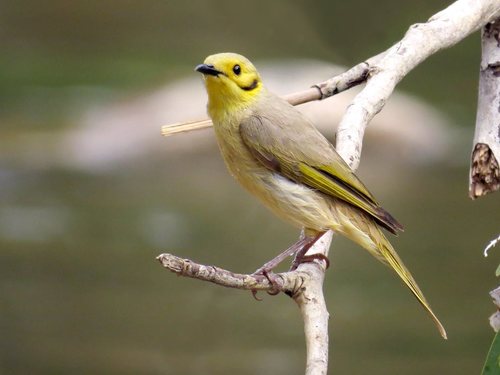
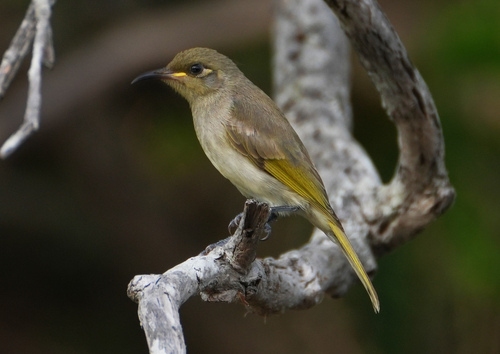
The brown honeyeater, scientific name Lichmera indistincta, is a bird species in the honeyeater family Meliphagidae. Honeyeaters, the group this species belongs to, have highly developed brush-tipped tongues adapted for feeding on nectar. While most honeyeaters are found mainly in Australia, New Guinea, and parts of Indonesia, the brown honeyeater is unique in also occurring on the island of Bali. This makes it the only honeyeater found west of the Wallace Line, the biogeographical boundary between the Australian-Papuan and Oriental zoogeographical regions. It is a medium-small brownish bird, with yellow-olive panels in the tail and wing, and a yellow tuft behind the eye. It is widespread across western, northern and eastern Australia, New Guinea and its surrounding islands, and the Lesser Sundas of Indonesia. Across this entire range, the brown honeyeater lives in a variety of habitats ranging from mangroves to eucalypt woodlands. It is seasonally nomadic within its local area, traveling to follow flowering food plants. While it usually forages alone, it can also feed in small groups, or in mixed-species flocks of other honeyeaters. Its diet consists of nectar and insects. It occupies the same breeding territory each year. It lays two or three eggs in a cup-shaped nest woven from grass and soft bark. Both sexes take part in nest building and feeding the young. It has a loud, clear, musical song, which has been described as the best among all honeyeaters. While the brown honeyeater has declining populations in some areas, such as the Wheatbelt region of Western Australia, its overall population size and distribution are large enough that the IUCN lists it as a species of least concern for conservation. The brown honeyeater occupies a wide range of wooded habitats and is widespread across Australia. The nominate subspecies ranges across a broad band from Newcastle on the New South Wales coast north and west through Queensland and the Northern Territory's Top End, reaching southwestern Western Australia. It is rarely seen in Sydney, where populations have declined since the late 1950s, though small numbers are still recorded in suitable habitats such as Homebush Bay and Kurnell. It is a vagrant to the Illawarra region. It is rare in South Australia, and not present in Victoria and Tasmania. Population densities for the species range from 2.3 birds per hectare (2.5 acres) in Kakadu National Park, to 0.26 birds per hectare in Wellard, Western Australia. The subspecies L. i. ocularis is found in New Guinea, the Torres Strait Islands, and Cape York, and interbreeds with the nominate subspecies along the Gulf of Carpentaria river system. The subspecies L. i. melvillensis inhabits the Tiwi Islands. L. i. limbata is found in Bali and the Lesser Sundas, and L. i. nupta lives on the Aru Islands. The brown honeyeater moves seasonally across its local area in response to the flowering of its food plants. For example, numbers increase noticeably in Toowoomba, southeast Queensland, during winter, and its range contracts in the Northern Territory during the dry season. It is commonly found among mangroves in coastal areas, including black mangroves (Rhizophora mucronata). It is often found in woodlands that transition into mangroves, such as those dominated by Banksia, Melaleuca or Callistemon, and is widespread in sclerophyll forests and eucalypt woodlands. In the arid and semi-arid inland of Australia, it is most often recorded in Acacia, Grevillea and Hakea shrubland along watercourses, and at bores, springs, and drainage lines. It visits flowering shrubs in parks and gardens, and occurs in remnant patches of trees on travelling stock routes.