About Lichmera incana (Latham, 1790)
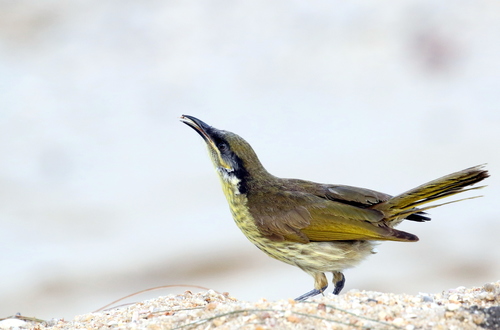
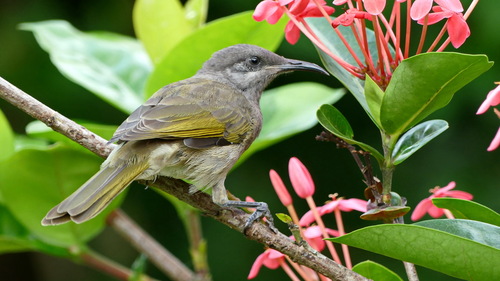
The grey-eared honeyeater, scientifically known as Lichmera incana (Latham, 1790), measures 13 to 17 centimeters in length, with males growing larger than females. Its upper plumage is mostly dull green-brown, while its underparts are grey with an olive tint. It has silvery-grey cheeks, a dark grey crown, a long, slightly downcurved black bill, and blue-grey legs and feet. Juveniles are paler than adults and lack the characteristic silvery cheeks. This species is noisy, and individuals start calling before dawn. Their call is a harsh tchoo-tchoo-tchoo, and they also produce a warbling song. Across most of its range, the grey-eared honeyeater is a common bird. It lives in lowlands and low hills across a variety of habitats, including forests, scrublands, mangroves, and gardens. There are five recognized subspecies of this bird. The nominate subspecies L. i. incana lives on Grande Terre, the main island of New Caledonia. Subspecies L. i. poliotis and L. i. mareensis are found on the Loyalty Islands, northeast of New Caledonia. Subspecies L. i. flavotincta and L. i. griseoviridis occur in Vanuatu. The breeding season of the grey-eared honeyeater typically runs from October to February. Its nest is constructed primarily from grass and plant fibers, bound together with spider webs. The nest is built in the fork of a branch on a tree or bush. Females lay a clutch of two eggs, which are white with a small number of reddish spots. The eggs are incubated for 14 days. Hatchlings are fed insects and spiders, and leave the nest 12 days after hatching.