About Lichenostomus melanops (Latham, 1801)
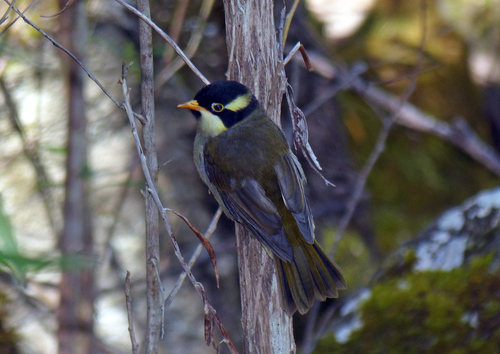
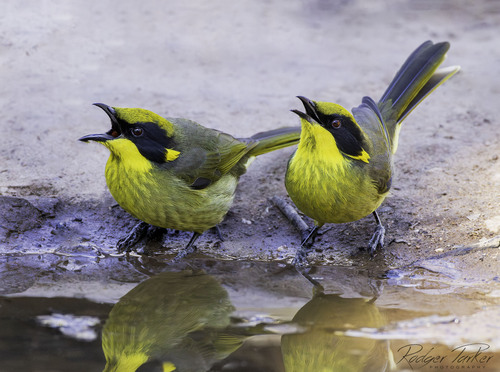
The yellow-tufted honeyeater (scientific name: Lichenostomus melanops (Latham, 1801)) measures 17–23 cm (6.7–9.1 in) in length, with females typically smaller than males. It has a bright yellow forehead, crown, and throat, a glossy black mask, and bright golden ear-tufts. Its back, wings, and tail range from olive-green to olive-brown, and its underparts are a more olive-yellow shade. The bill and gape are black, the eyes are brown, and the legs are grey-brown. This bird is distributed from south-east Queensland through eastern New South Wales and across Victoria. Its preferred habitats are dry open sclerophyll forests and woodlands dominated by eucalypts with shrubby undergrowth, as well as mallee, brigalow, and cypress-pine (Callitris). The helmeted honeyeater subspecies is largely restricted to dense riverbank vegetation dominated by mountain swamp gum (Eucalyptus camphora), with a dense understorey of woolly tea-tree (Leptospermum lanigerum), scented paperbark (Melaleuca squarrosa), saw-sedge (Gahnia), ferns, and tussock grasses.