About Lichenostomus cratitius (Gould, 1841)
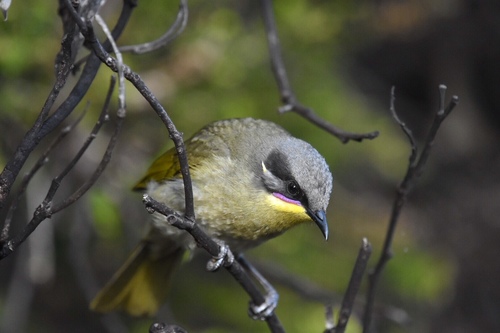
The purple-gaped honeyeater, whose scientific name is Lichenostomus cratitius (Gould, 1841), is also called the Wattle-Cheeked Honeyeater in Gregory Mathews' *Birds of Australia* volume 11. This is a medium-sized honeyeater, measuring 16 to 19 centimetres long. Its upperparts are generally grey-olive, while its underparts are buffish yellow. It has a patterned head: a black eyestripe sits against grey background plumage, it has a purple gape above a yellow throat streak, and it bears pointed yellow ear coverts. Juveniles look similar to adults, but have duller facial patterns, slightly browner plumage, and a yellow gape and gape line. The subspecies native to Kangaroo Island is larger and darker than the mainland subspecies. The purple-gaped honeyeater is similar in appearance to two other species: the yellow-plumed honeyeater and the singing honeyeater. This species occurs in disjunct populations across southern Australia, ranging east from southern Western Australia. Its eastern population is found largely south of the Murray River, and New South Wales forms the extreme north-eastern edge of the species' range. Even though the species naturally has split, disconnected populations, it has very low genetic diversity across its entire range. The primary habitat of the purple-gaped honeyeater is mallee woodland and shrubland, including bull mallee with patches of green mallee or blue mallee. It also occurs in yellow gum woodland with dense thickets of 'totem-poles' or violet honey-myrtle, located on low-lying flats and gullies within mallee areas. It is occasionally recorded in river red gums that border waterways, and seasonally found in red ironbark woodlands when those trees are flowering. Occasionally, purple-gaped honeyeaters can also be found in gardens. This species is gregarious, and is usually seen in pairs or in groups of 3 to 8 birds. It is generally described as quiet and unobtrusive, except during spring when it may call frequently. It regularly drinks and bathes, especially in warmer weather. Purple-gaped honeyeaters associate with yellow-plumed honeyeaters and tawny-crowned honeyeaters, but can be aggressive toward other honeyeaters, and frequently chase other birds, particularly while feeding. For reproduction, purple-gaped honeyeaters build small cup-shaped nests made from bark strips, grass, and down, bound together with spider web and spider egg sacs. The nest is slung from a horizontal fork or slender branchlets within dense foliage, most commonly in broombush or eucalypts, and is normally placed less than three metres above the ground.