About Lichenaula calligrapha Meyrick, 1890
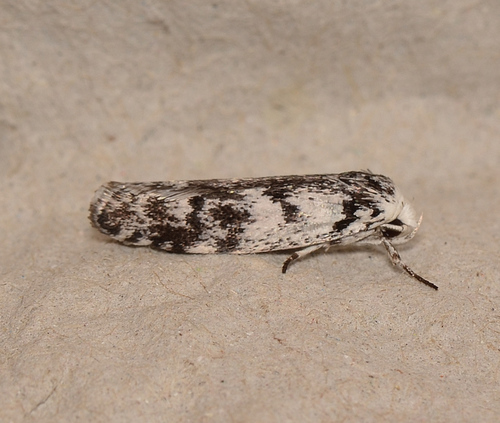
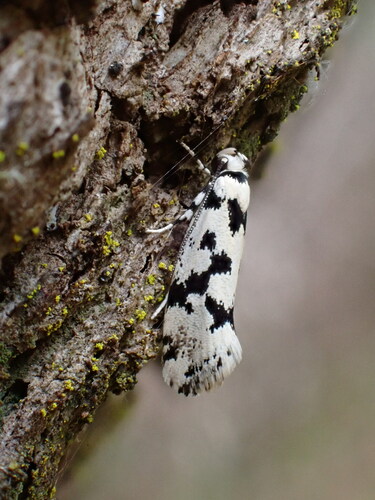
This species description covers both male and female individuals of Lichenaula calligrapha, which have a body length of 16-17mm. The head is white, and the palpi are also white, with black coloration on the base of the second joint as well as the base and apex of the terminal joint. The antennae are white, ringed with blackish color; males have antennal ciliations measuring 1. The thorax is white, with a narrow black margin along the anterior edge, and a backward-pointing projection on each side of the posterior thorax. The abdomen is whitish. The legs are white, with the anterior and middle pairs banded with blackish color. The forewings are elongate, with a gently arched costa, round-pointed apex, and a nearly straight, oblique hindmargin; vein 7 extends to the apex. The forewing ground color is ochreous-white, and all markings are black. Markings include a spot on the base of the costa, another spot on the inner margin near the base, an irregular-edged streak running from the costa beyond the middle to the submedian fold before the middle (its lower end is almost connected to a small discal spot at one-third wing length), an upright mark originating from the inner margin before the anal angle with an acutely forked apex, two small marks on the costa towards the apex, and scattered black scales that form an apical suffusion. The forewing cilia are ochreous-white, more or less distinctly barred with grey, and have an interrupted blackish line. The hindwings are whitish grey, whiter towards the anterior, with grey color at the apex; the hindwing cilia are grey-whitish, with faint traces of a darker line. Specimens have been collected from Sydney, New South Wales and Launceston, Tasmania, in November and January, totaling three specimens. The larvae are thought to feed on lichens.