About Lichanura trivirgata Cope, 1861
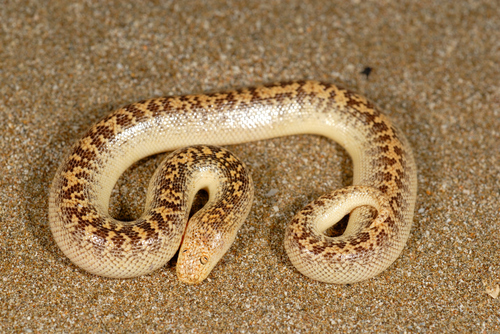
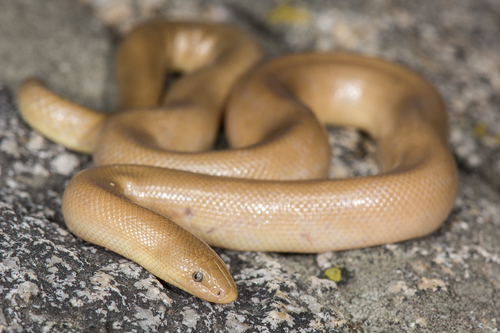
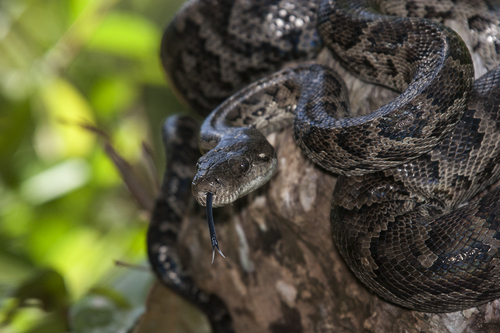
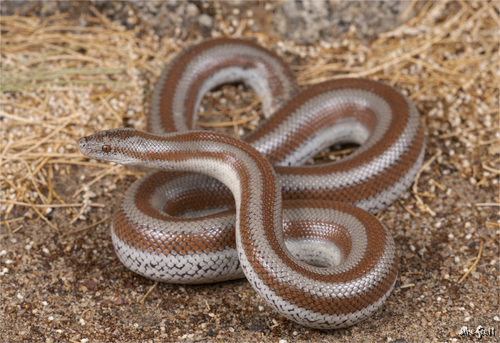
Lichanura trivirgata, commonly known as the desert rosy boa, is classified as a small snake, and is one of the smaller species in the Boidae family. Adults normally reach a total length including the tail of 43–112 cm (17–44 in), and exact length varies by subspecies. A large adult has a body width roughly equal to the diameter of a golf ball. This species has highly variable coloration that is typically specific to its native locality. Some individuals have rosy or salmon coloration on their underside; most desert rosy boa specimens lack this ventral coloration, and instead have a series of dark to orange spots on a light-colored background. Almost all desert rosy boa specimens have at least some trace of three longitudinal stripes: one runs down the center of the back, and two run along the lower sides. The appearance of these stripes varies widely: they can be extremely straight with high contrast against the interstriped areas (interspaces), or extremely broken with almost no contrast against the interspaces. Stripe colors may be orange, maroon, rust, brown, or black. Interspace colors may be shades of light to dark gray, yellow, or tan. The desert rosy boa is native to the Aridoamerica ecoregion, found in the southwestern United States (the states of California and Arizona) and northwestern Mexico (the states of Baja California and Sonora). In California, the species lives in extreme southern San Diego County, within the Tijuana River and Otay watersheds. In Arizona, it occupies the western areas of the Sonoran Desert. In Sonora, its range extends from the United States border south throughout the Sonoran Desert, reaching at least as far south as Ortiz. In Baja California, the desert rosy boa is nearly ubiquitous across the entire peninsula, and is absent only from areas of extremely dry or rockless desert. The desert rosy boa gives birth to live young. Broods typically contain about six young, and newborns can reach up to 30 cm (12 in) in length.