About Lichanura orcutti Stejneger, 1889
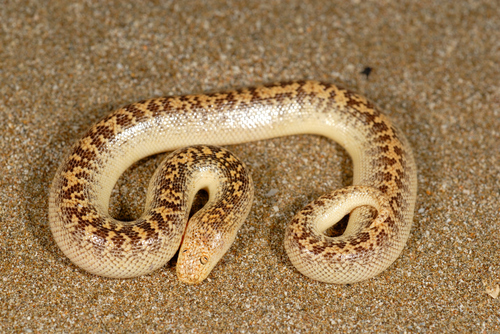
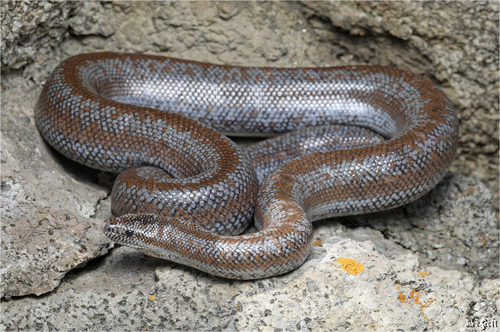
Lichanura orcutti is a heavy-bodied snake with smooth scales and a tapered, blunt tail. Its head is only marginally wider than its neck, and it has vertical pupils. Adult individuals range in total length from 17 to 44 inches (43 to 112 cm), though they rarely grow longer than 36 inches (91 cm). Newly hatched young are 10 to 14 inches long. Males of this species typically have well-developed anal spurs. Lichanura orcutti has three lengthwise stripes that run along its dorsal and lateral surfaces. The stripes can be tan, orange, brick red, or reddish-brown, with color varying by location; the interspaces between the stripes range in color from blue-grey to tan, yellow, or nearly white. Stripes also range from sharply defined to very faint between individual snakes. Younger individuals usually have lighter overall coloration and more clearly defined striping than adults. Despite the popular common name "rosy boa", most individuals do not have the rosy ventral coloration that gave the species this common name. This species is found north of the US–Mexico border, within San Diego County, California, and along the coastal Peninsular Ranges. Its range extends northward into the Mojave Desert, and eastward into the Sonoran Desert of California and Arizona. It also occurs in southern Nevada. Lichanura orcutti inhabits arid scrublands, semi-arid shrublands, rocky shrublands, rocky deserts, canyons, and other rocky areas. It may be more common in riparian areas such as oases and permanent or intermittent streams, but it does not require permanent water to survive. The IUCN Red List notes that the species' preference for rocky habitats, which are unsuitable for development or agriculture, may protect Lichanura orcutti from habitat loss. Lichanura orcutti is primarily nocturnal, with peak activity at dusk, during the night, and at dawn. During cooler weather, it may also be seen basking in early morning or late afternoon. During bad weather, and in the hottest and coldest months of the year, Lichanura orcutti stays inactive inside burrows or underneath cover. This species is live-bearing, and young are born between October and November. Females generally give birth to 3 to 14 young at a time.