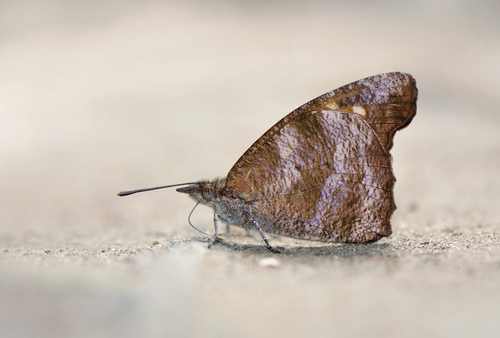
About Libythea geoffroy Godart
This is a description of the race alompra Moore of Libythea geoffroy Godart. Males have a pale brown upperside. On the forewing, the cell, the basal two-thirds of interspaces 1a, 1, 2 and 3, and the extreme base of interspace 4 are suffused with a beautiful pale violescent blue; there is also a curved series of three subquadrate preapical white spots. On the hindwing, the cell is suffused with violescent blue that extends faintly into interspaces 4, 5 and 6; a faintly marked dull orange band sits below the lower apex of the cell. The underside is pale brown. On the forewing, the apex is grey, sprinkled with minute dark spots; the cell has a broad dull orange streak starting from the base, followed by a violescent transverse spot in the apex of the cell; a large discal dull violescent spot in interspace 2 spreads slightly into interspace 3, and the curved series of three preapical spots matches those on the upperside but is faintly dull violescent. The hindwing is greyish brown, sprinkled with dark spots and transverse dark striae, and shaded with darker brown; the medial dull orange band is replaced by a similar pale, well-marked band. Antennae, head and abdomen are pale brown; the thorax is darker brown with a small amount of greenish pubescence on its posterior end; on the underside, the palpi, thorax and abdomen are pale greyish brown. Females have a upperside where the forewing's violet area is duller and restricted to the immediate base of the wing; there is a quadrate white spot at the end of the discoidal cell, a tripartite subcostal spot, another elongated spot extending from the third median to the upper discoidal nervule placed outwardly below it, and a large quadrate discal spot that completely fills the interspace between the first and third median nervules. The female hindwing has no violet gloss at the base and is otherwise identical to the male's. On the female underside, the forewing's cell is orange, but is outwardly terminated by a large white spot; all other spots match those on the upperside. The female hindwing matches the male's, but all markings are more obscure. This description is taken from work by Lionel de Nicéville.