About Libinia emarginata Leach, 1815
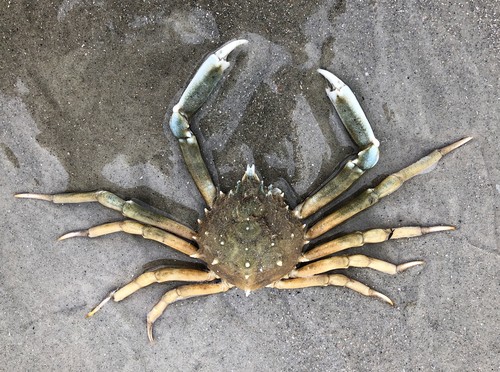
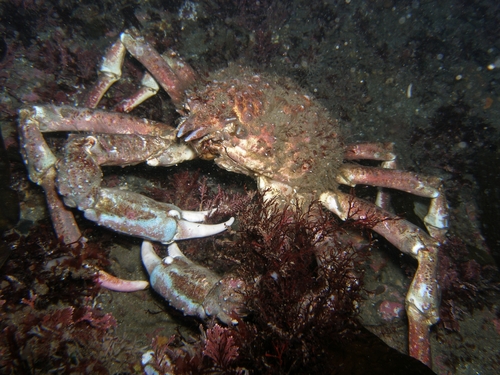
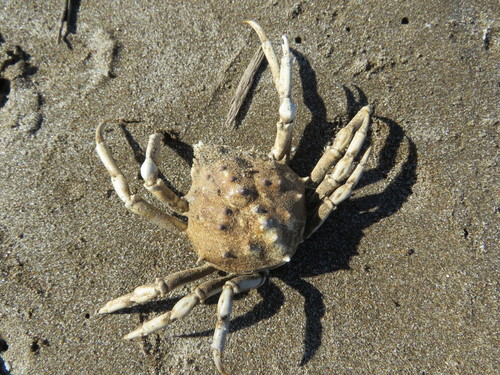
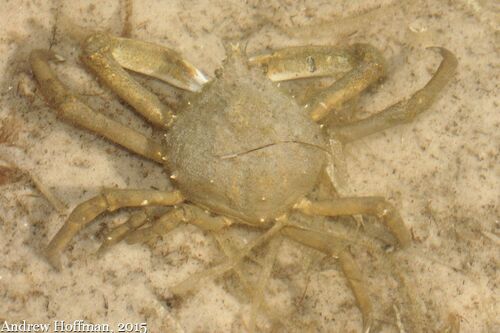
Libinia emarginata Leach, 1815 has a roughly triangular body outline and a heavily calcified exoskeleton. Its carapace measures approximately 4 inches (100 mm) in length, and its total leg span reaches 12 inches (300 mm). The entire body of the crab is khaki-colored, and the carapace is covered in spines and tubercles. Like other decorator crabs, it often covers itself in debris and small invertebrates.
This species is distributed from Nova Scotia to the Florida Keys, and throughout the Gulf of Mexico. It typically inhabits depths of up to 160 feet (49 meters), with exceptional records of individuals found as deep as 400 feet (120 meters). It can live on a variety of substrates, at depths up to 150 feet (46 meters).
Mating occurs and eggs are produced between June and September. Newly laid eggs are bright orange-red, and darken to brown as they develop over approximately 25 days. After development is complete, the eggs hatch into zoea larvae. Unlike females of many other crab species, which only mate immediately after molting, female Libinia emarginata can produce another brood of eggs within 12 hours of hatching.
Adult Libinia emarginata are sluggish and not aggressive. Younger crabs are frequently covered in sponges and hydroids. In comparison to other predatory crab species, Libinia emarginata is smaller in size, but it preys on large starfish such as Asterias forbesi. Unusually for crabs, this species prefers to walk forwards rather than sideways, though it is also capable of moving sideways. Its skeletal, muscular, and neural anatomy is more similar to that of forward-walking crab species than to its closer sideways-walking relatives.
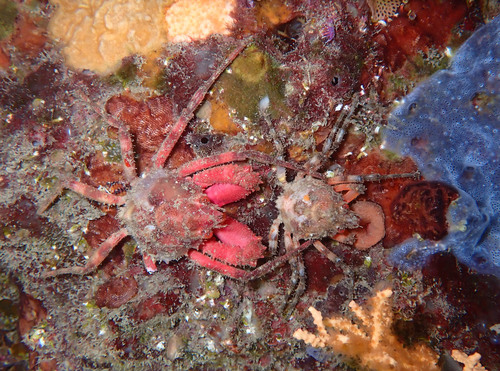
Libinia emarginata mates in large aggregations, which may act as a protective mechanism during reproduction. Males of this species display an unusual "obstetrical behavior": they hold gravid females that are about to release their larvae behind themselves and protect them aggressively.