About Libinia dubia H.Milne Edwards, 1834
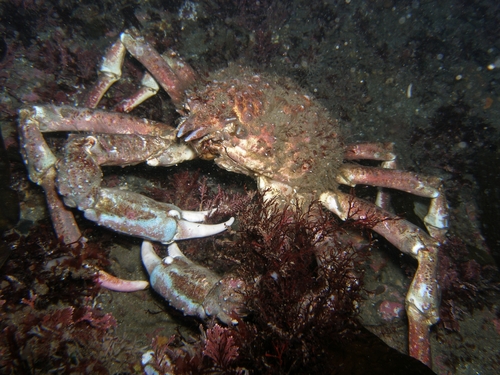
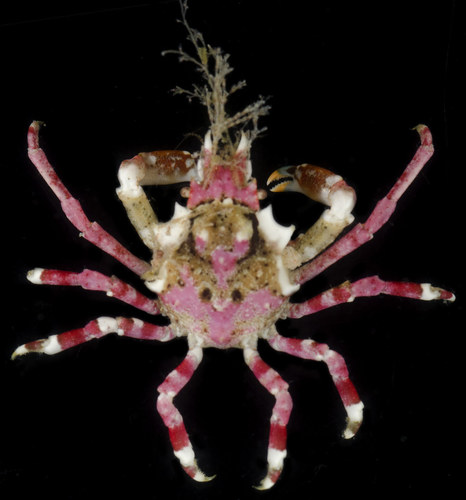
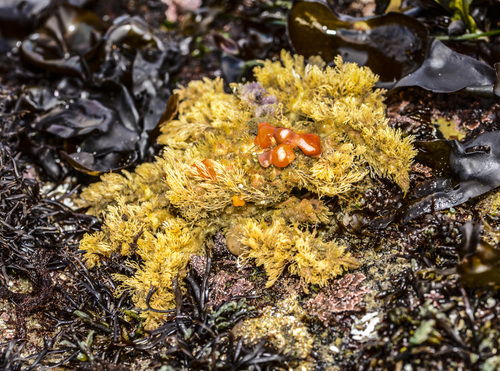
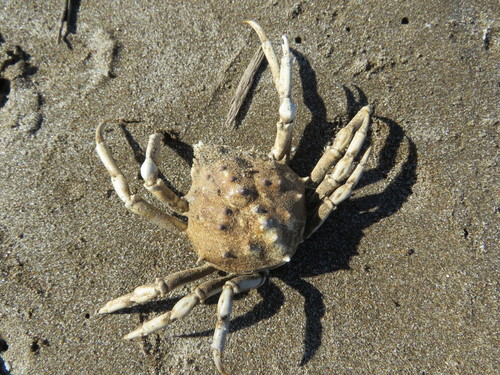
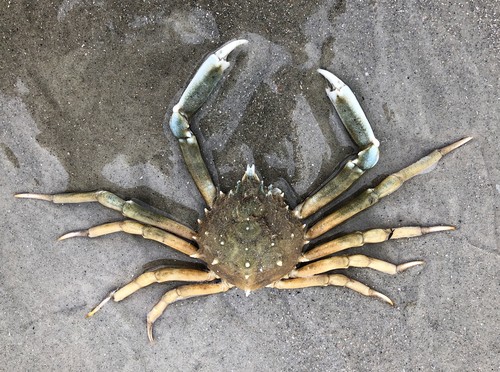
Libinia dubia, commonly called the longnose spider crab, has a nearly circular carapace, with an average diameter between 6 and 10 centimetres (2.4 to 3.9 in), and males grow larger than females. Each side edge of the carapace bears around six spiny protuberances, with another six running along the shell's midline. The upper surface of the carapace is covered in short, hooked setae (bristles) that have a velcro-like texture; the crab uses these to attach pieces of seaweed and other organisms to itself for camouflage. It has two small stalked eyes, and between these eyes, the carapace extends forward into a forked rostrum. It has five pairs of long, thin, jointed walking legs; the front pair ends in rather small pincers, and the terminal joint of the remaining legs forms a curved claw. The longnose spider crab can be confused with the portly spider crab, Libinia emarginata, but that species usually has nine spines along each side margin of the shell. The longnose spider crab is found along the eastern seaboard of the United States, ranging from Cape Cod to southern Texas, and also occurs in Cuba and the Bahamas. It inhabits waters down to a depth of about 50 metres (160 ft). Within the Indian River Lagoon, adult longnose spider crabs live on sandy bottoms, while juveniles live in seagrass meadows. In the late 1900s, this crab was identified off the coast of Tunisia, though how it crossed the Atlantic Ocean remains unclear. During breeding, the male transfers bundles of sperm called spermatophores to the female. Fertilization is internal, after which the female broods the eggs under her abdomen until they hatch. The hatching larvae become part of the zooplankton, and develop through two zoeal stages followed by one megalopal (post-larval) stage. After completing this development, the larvae settle on the seabed and undergo metamorphosis into juvenile crabs. The longnose spider crab is a scavenger and detritivore, and in seagrass meadows it feeds on the seaweeds that grow there. It is preyed on by predatory fish including the pinfish (Lagodon rhomboides), the gag grouper (Mycteroperca microlepis), and the oyster toadfish (Opsanus tau). It avoids predation by attaching unpalatable seaweeds and invertebrates to its carapace, such as the brown alga Dictyota menstrualis and the sun sponge (Hymeniacidon heliophila). Along the U.S. East Coast where Dictyota menstrualis occurs, these crabs recognize this chemically noxious alga and select it preferentially for camouflage. In areas where D. menstrualis is not present, L. dubia uses alternative camouflage methods and does not appear to recognize D. menstrualis. As the crab grows larger, it no longer needs this form of camouflage, because its shell becomes too large for predators to eat. It sometimes acts as an epibiont on the carapace of the loggerhead turtle (Caretta caretta). Longnose spider crabs are also often found living inside the bells of cannonball jellies (Stomolophus meleagris). It is thought that they gain entry as juveniles when jellyfish drift near the seabed, or that they may metamorphose from larvae directly inside the jellyfish's bell. This is likely a symbiotic relationship where the crabs gain protection from predators and access to food from their host, but any benefit to the jellyfish is unclear—especially because the crab may nibble the jellyfish's tissues.