About Liasis olivaceus Gray, 1842
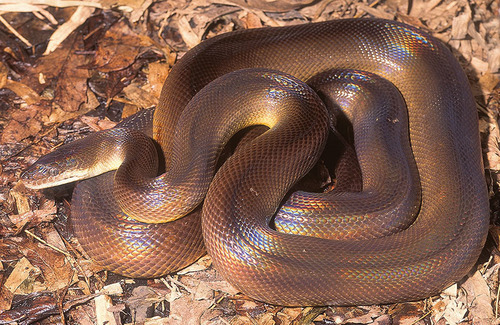
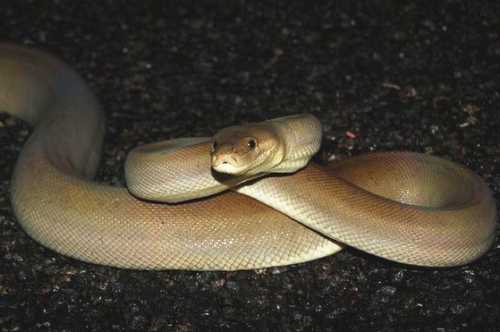
Liasis olivaceus Gray, 1842 is Australia's third-largest snake species, with adults reaching over 4 meters (13 feet) in total length including the tail. Only the amethystine python and Oenpelli python grow larger than this species. It has 61–72 dorsal scale rows at midbody, a higher count than other pythons that gives its skin a smoother appearance. It has 355–377 ventral scales. Its body has a uniform color ranging from chocolate brown to olive green, and its belly is usually cream-colored. Adults typically weigh 10–20 kilograms (22–44 pounds), and large females can exceed 20 kilograms (44 pounds) when kept in captivity. This species is occasionally misidentified as the venomous king brown snake (Pseudechis australis), and is often mistakenly killed as a result. Liasis olivaceus is distributed across Western Australia, the Northern Territory, and Queensland in Australia. Its given type locality is "North Australia; Port Essington", located in the Northern Territory, Australia. The olive python inhabits rocky areas, gorges, and particularly rocky regions located near water sources. It most commonly seeks shelter in caves and rock crevices, but individuals have also been found in hollow logs and burrows under rocks. Olive python mating activity begins in May and continues through mid-July. After successful mating, females go through a gestation period of 81–85 days. As an oviparous species, females lay 12–40 eggs in late spring, with an average clutch size of around 19 eggs. Hatchlings emerge after an incubation period of approximately 50 days, and each hatchling measures about 35 cm in length.