About Liasis fuscus Peters, 1873
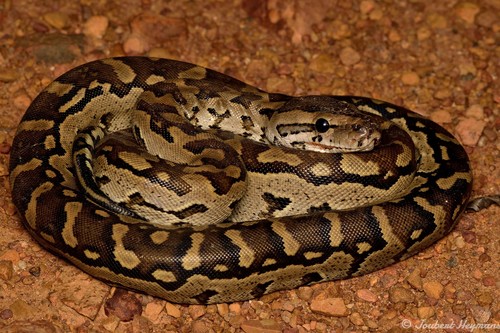
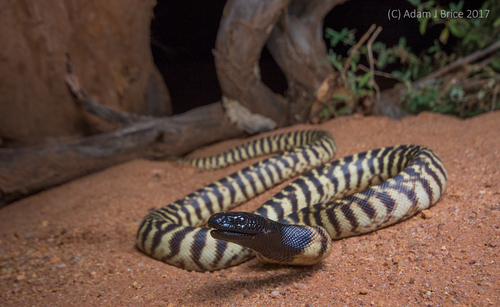
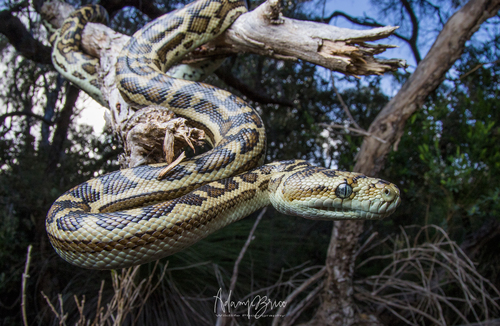
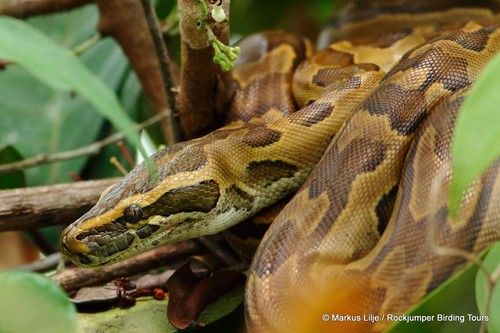
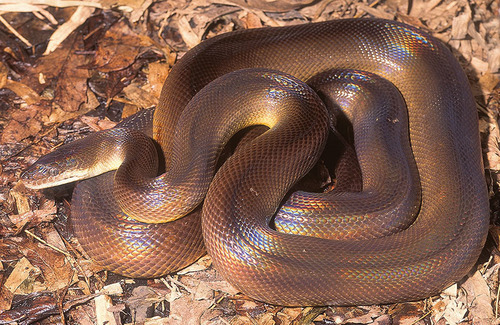
Adults of this species average 6–8 feet, which is around 2 or more meters, in total length, and may reach up to 10 feet, 3.0 meters. Individuals are robustly built, with a long head that is slightly distinct from the neck. The anterior supralabials bear thermosensitive pits. Its head scalation includes a pair of undivided parietal scales, and one single loreal scale on each side of the head. On the midsection of the body, there are 45 to 55 dorsal scales; there are also 270 to 300 ventral scales, a single anal scale, and 60 to 90 paired subcaudal scales. Its color pattern has a uniform, iridescent dark blackish brown dorsal color. The belly ranges from dull to bright yellow, and this yellow coloration extends onto the first few rows of dorsal scales. The throat is cream-colored, while the upper labials are light gray-brown marked with dark brown or black spots. This species is distributed across Australia: it occurs in the Kimberley district of northern Western Australia, starting from around Broome and extending east through the Northern Territory at least as far south as Mataranka, continuing to the coast of central Queensland near Mackay. It is also found on the Sir Charles Hardy Islands, on Cornwallis Island in the Torres Strait, in the Western District of Papua New Guinea in the lower Fly River region at least as far inland as Lake Daviumbo, and in the southern part of the Papuan province of Indonesia. Its given type locality is "Port Bowen", which corresponds to Port Clinton, Queensland, Australia. The species reaches its highest population density on the Adelaide River floodplains in the Northern Territory. Mating occurs during July–August, which is the middle of the dry season. After mating, there is a gestation period of approximately one month, after which females lay an average of 12 eggs. Hatchlings emerge after an incubation period of 57 to 61 days, and each hatchling is around 30 cm in length.