About Lialis burtonis Gray, 1835
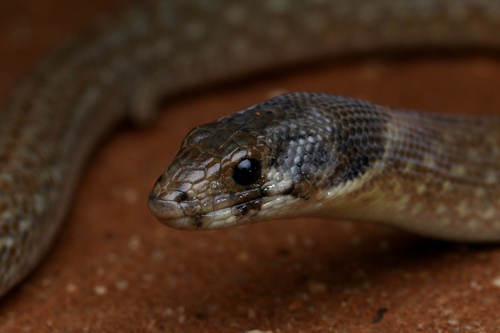
Burton's legless lizard (Lialis burtonis Gray, 1835) has several key morphological adaptations that help it subdue large struggling prey. First, it has a skull with an elongated snout, paired with pointed, recurved, hinged teeth that may help it grip prey. The elongated snout may also support binocular vision, allowing it to strike more accurately. Another adaptation that helps the lizard hold prey is flexible mesokinetic and hypokinetic jaw joints, which let its jaws encircle large prey items. Finally, the species can retract its eyes; this is especially important because it is a visual predator that depends on eyesight, and retraction protects the eyes during conflict with prey.
Burton's legless lizard is found across almost all of Australia, but is absent from parts of southern Australia including Tasmania. It also occurs in a single small restricted area in Papua New Guinea. The species lives in a wide range of habitats, from deserts to rainforest margins, but is not found in southern alpine areas or extreme northern deserts. It typically occurs in low vegetation or ground debris, most notably leaf litter; an experiment with tropical populations found that when offered multiple thermally similar habitats, the lizards strongly preferred leaf litter. Where leaf litter is not common, the species will use grasses, abandoned burrows, and other available shelter.
Reproduction in Burton's legless lizard is generally seasonal across Australian populations, with mating occurring around the same time across the region. Mating and ovulation most often take place from September through summer. The species is oviparous, and eggs are usually laid between November and January, but reproduction can happen outside the typical breeding season, and females can lay more than one clutch per year. Eggs are laid under logs or rocks, on the ground, under leaf litter, and sometimes in the nests of sugar ants. Clutches can be laid in quick succession, and each clutch holds 1 to 3 tough, leathery eggs; a clutch size of 2 is the most common by far. Nesting can be communal, and up to 20 eggs have been found in a single nest. Females of the species are capable of either storing sperm to use for reproduction later, or reproducing via parthenogenesis, which does not require mating to produce offspring. Newly hatched Burton's legless lizards are approximately 13 centimetres long.