About Leymus mollis (Trin.) Pilg.
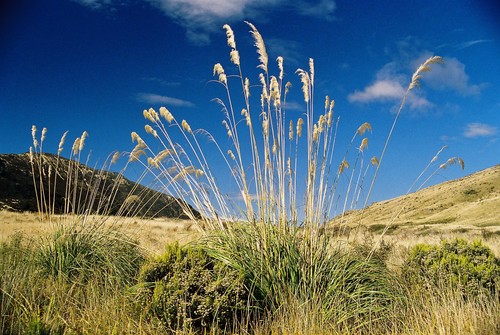
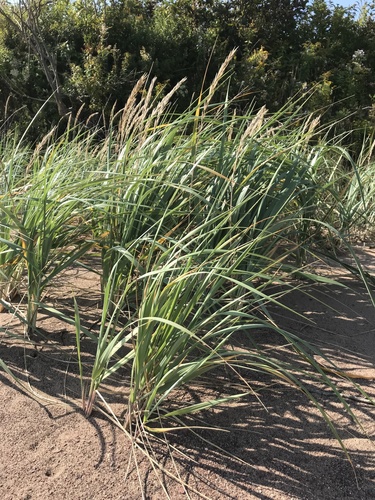
Leymus mollis (Trin.) Pilg. is a grass species with the common names American dune grass, American dune wild-rye, sea lyme-grass, strand-wheat, and strand grass; its Japanese name is hamaninniku. It is native to Asia, where it grows in Japan, China, Korea, and Russia, as well as northern North America (across Canada, the northern United States, and Greenland), and it can also be found in Iceland. This grass typically occurs in coastal habitat, especially on dunes, and plays an important role in dune ecology. It most often grows on foredunes and embryo dunes, and less often on backdunes. It is one of the first plant species to establish during ecological succession in the early stages of sand dune development. In loose, ocean-facing dunes, it tolerates challenging conditions including salt spray, salty sand, little to no fresh water, unstable substrates, occasional inundation during storms, low nutrient levels, and abrasion by wind, water, and ice storms. Seedlings may become buried, and this environment causes plant stress. Leymus mollis grows from a large rhizome that anchors the plant in shifting, unstable sand. When many plants grow on a dune, their connected rhizomes form a network that stabilizes the dune and prevents erosion. This network has been called "the skeleton of the foredune," making the species valuable for landscape rehabilitation in native beach habitats. Beyond dune stabilization, the species has other human uses. Its drought resistance is suggested for use in restoration projects, and it may have applications in wheat breeding. Historically, several Indigenous groups have used the plant for various purposes: the Makah, Nitinaht, and Quileute used bunches of the thick roots as body scrubs during bathing; Yupik peoples use the leaves to make mats, baskets, bags, and ropes for hanging fish to dry; the Hesquiat wove the leaves into handles for sacks; the Kwakwaka'wakw make baskets and hats from the leaves, and traditionally used them to line boxes used for cooking lupine roots; the Nitinaht used the plant's pointed leaves for sewing and tying; the Haisla and Hanaksiala used the grass to line pits prepared for processing eulachon fish oil; the Quinault placed salal fruits to dry on a bed of the leaves; Canadian Inuit have traditionally used Leymus mollis both to treat stomach problems and to weave baskets, and used dried leaves to insulate their boots.