About Lewisia pygmaea (A.Gray) B.L.Rob.
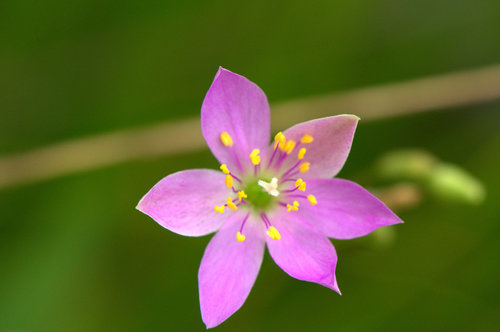
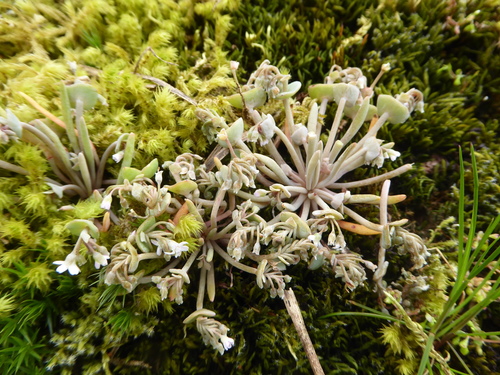
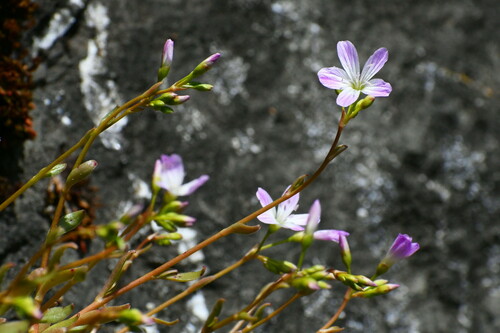
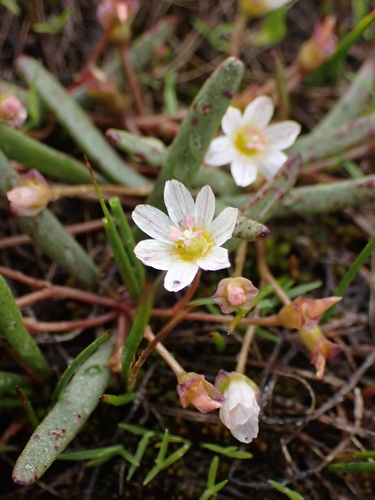
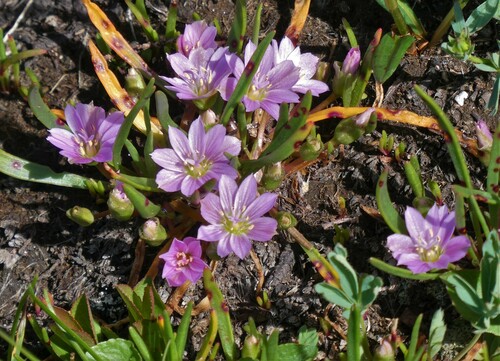
Lewisia pygmaea is a highly variable species with a wide distribution, and it often hybridizes with other Lewisia species, which makes identification difficult. In general, this is a petite perennial herb that grows from a taproot and caudex unit, producing a basal rosette of several leaves that measure 2 to 8 centimeters (0.8 to 3.1 inches) long. The leaves are narrow but thick and fleshy, with blunt tips, and range in shape from linear to lance-shaped. Its inflorescence is usually made up of a few very short stems, each bearing one or more flowers that appear to sit on or within the basal leaf rosette. Each flower has 5 to 9 white, pink, or red petals, which may or may not have dark veining or striping. The petals measure 0.4 to 1 centimeter (0.16 to 0.39 inches) long. Lewisia pygmaea grows in open areas with short turf, and in gravelly or rocky soils. It occurs naturally in Alberta, British Columbia, Yukon; and the U.S. states of Arizona, California, Colorado, Idaho, Montana, Nevada, New Mexico, Oregon, Utah, Washington, and Wyoming.