About Lewisia oppositifolia (S.Watson) B.L.Rob.
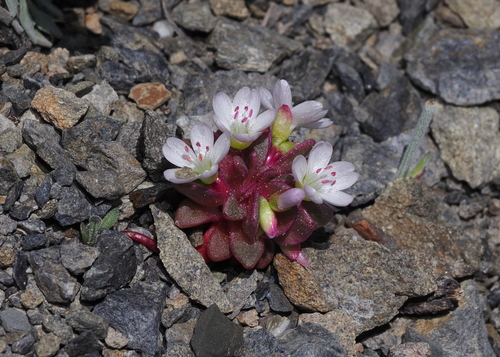
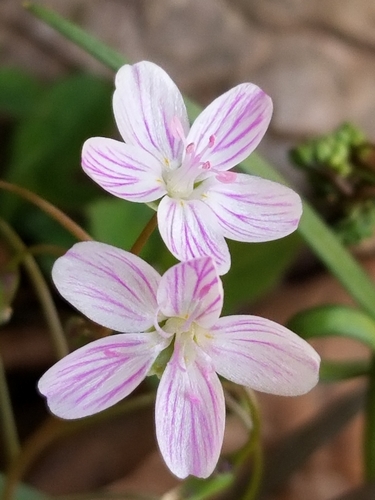
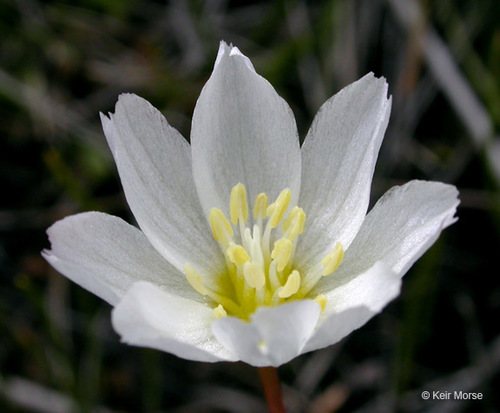
Lewisia oppositifolia, commonly called opposite-leaf lewisia, is a rare flowering plant species in the family Montiaceae. It is native to the Klamath Mountains of Josephine County, Oregon, and Del Norte County, California, where it is a local serpentine endemic that grows most often in moist areas. This plant is a perennial herb that grows from a small taproot and connected caudex. It forms a basal rosette of several fleshy, lance-shaped leaves with blunt tips, which can grow up to 11 centimeters (4.3 inches) long. Smaller leaves sometimes grow along the lower part of the stem. Its inflorescence consists of one or more erect stems reaching around 20 centimeters (8 inches) long, and each stem holds between 1 and 6 flowers. Each flower has 8 to 11 petals that range in color from white to pale pink, with blunt or jagged tips. The petals measure between 1 and 2 centimeters (0.4 to 0.8 inches) long. Several stamens with pale anthers are located at the center of the flower. This species has a limited native distribution and is threatened by local human activities such as logging.