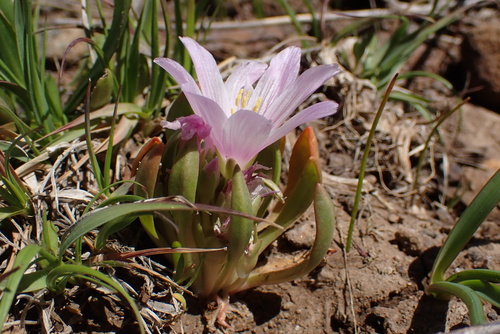
About Lewisia brachycalyx Engelm. ex A.Gray
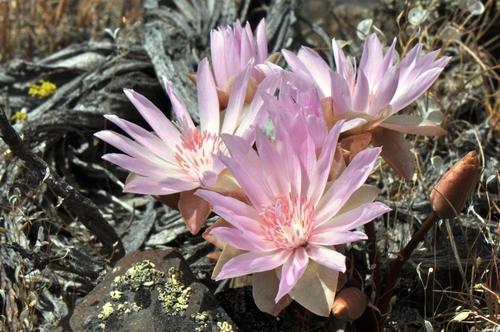
Lewisia brachycalyx Engelm. ex A.Gray is a deciduous perennial that grows from a short, thick taproot and caudex unit. It forms a basal rosette of thick, fleshy, narrow, blunt-tipped leaves that reach up to 8 centimeters (3.1 inches) long. The inflorescence grows less than 4 centimeters (1.6 inches) tall, appearing as a cluster of several flowers that sits directly on top of the leaf rosette. Each flower holds 5 to 9 shiny white or pink petals, each around 2 centimeters (0.8 inches) long. The center of the flower contains many stamens and stigmas grouped tightly together. The Latin specific epithet brachycalyx translates to "having a short calyx". In 2009, with the adoption of the APG III system, the genus Lewisia was moved from the purslane family (Portulacaceae) to the newly established family Montiaceae. For cultivation, this plant is hardy to temperatures as low as −10 °C (14 °F). It needs well-drained soil with an acid to neutral pH, grown in full sun. It enters dormancy after flowering during the summer. It is well-suited for planting in an alpine garden, where the growing conditions can best match its natural habitat. This species has earned the Royal Horticultural Society's Award of Garden Merit.