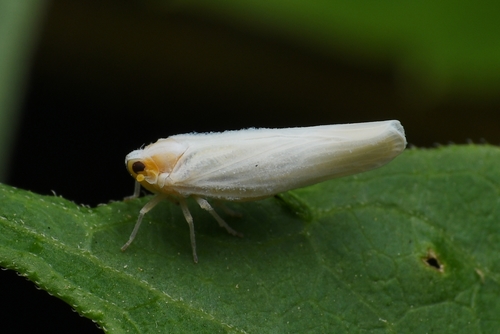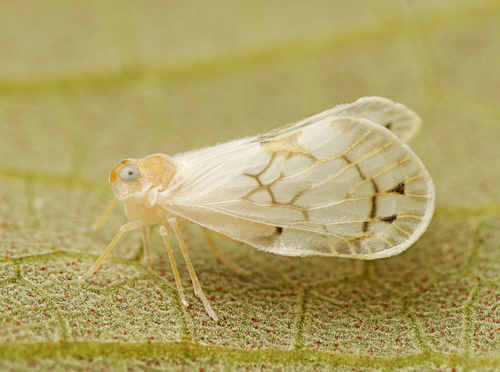
About Levu vitiensis Kirkaldy, 1906
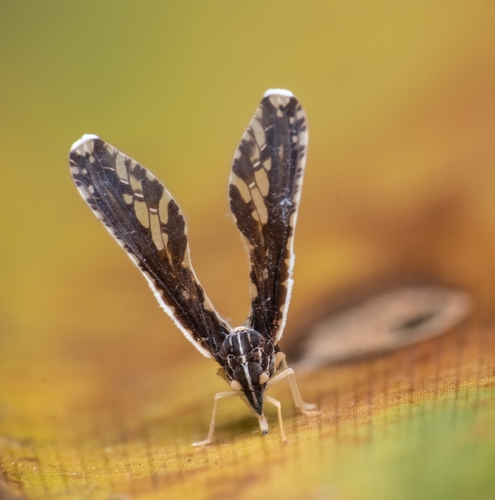
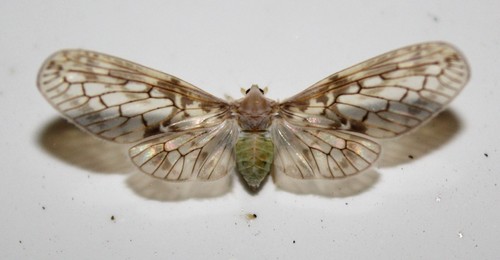
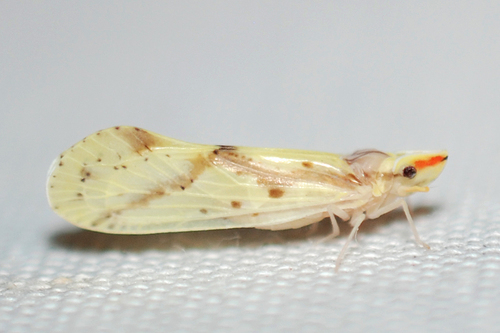
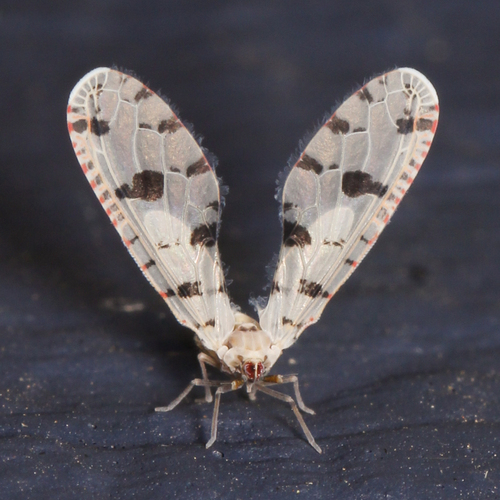
Genus Levu shares similar forewing venation with its sister genus Rhotana. In general, Levu forewings are narrower than those of Rhotana, particularly the basal median cell. Levu species are also smaller than Rhotana species, though the smallest Rhotana species are similar in size to the largest Levu species. Levu forewings are less transparent and often lightly powdered. They have few conspicuous markings, and lack the colour pattern commonly seen in Rhotana, but some species, such as L. rufulus and L. nocturnus, have dark brown forewings. Levu hind wings always have no markings. When the insects are at rest, their wings may be held in a roof-like (tectiform) position, or lie in a common plane like the wings of house flies. While most Levu species have a uniformly straw-coloured body, some species have red or orange marks on the head, for example around the eyes or along the facial frons, as seen in Levu knighti. The forewing venation of Levu samoensis is unusual: the two sub-branches of the first branch of the media curve toward one another and touch briefly around the halfway point before reaching the wing margin. This characteristic venation is found in 7 species, which are grouped together as the "Levu samoensis species group". Most Levu species have been recorded from western Pacific islands, especially Melanesia. This includes 7 species from New Guinea, 7 from the Solomon Islands, 4 from Vanuatu, 2 from Fiji, and 1 from New Caledonia. Levu species also occur in Polynesia (3 species), Micronesia (5 species) and the Philippines (6 species). One or two species each have additionally been recorded in Australia, Indonesia, Taiwan and mainland Asia. The type species, Levu vitiensis Kirkaldy, 1906, has an unusually wide distribution compared to other Levu species. Its range extends from Fiji in the east to Australia in the west, reaches as far south as New South Wales, and includes parts of the Solomon Islands, Vanuatu and New Caledonia.