About Leviprora inops (Jenyns, 1840)
Common name: longhead flathead, scientific name: Leviprora inops (Jenyns, 1840)
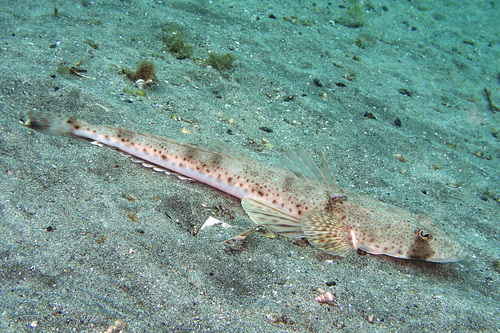
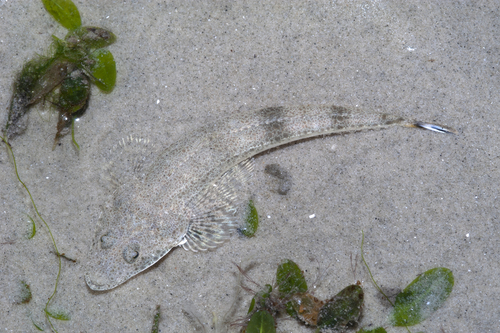
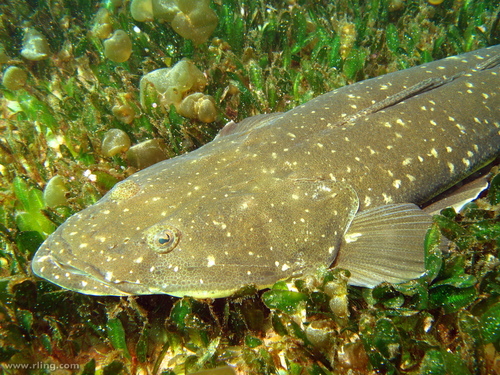
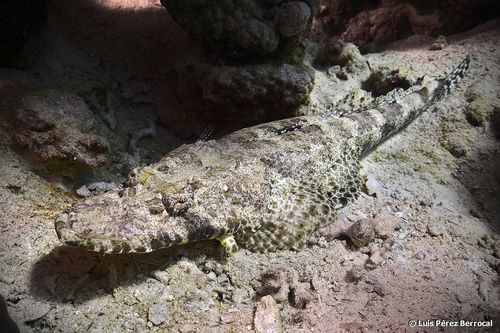
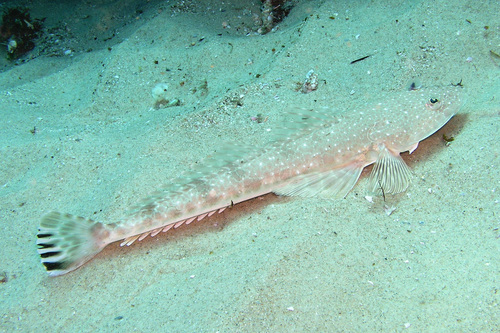
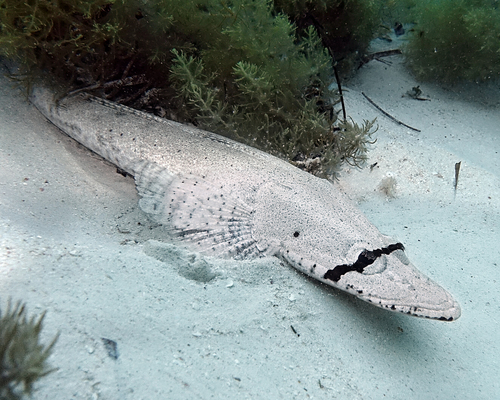
This species has an elongated, slightly flattened body with a very long head; the head makes up two-fifths of its standard length. The head is highly flattened, comparatively smooth, and has very few low, bony ridges. It has large eyes, with a long, fringed lappet on the iris. The mouth is large, with a wide band of small teeth on each jaw, and two distinct patches of vomerine teeth. There are two very small spines on the angle of the preoperculum.
The short-based first dorsal fin has 8 or 9 spines; the first spine is separate and very short. The long-based second dorsal fin contains 12 soft rays. The anal fin sits opposite the second dorsal fin, and has a similar shape, with between 11 and 13 soft rays. The maximum recorded total length is 61 cm (24 in), and the maximum recorded weight is at least 2.5 kg (5.5 lb). The upper body is sandy to pinkish, marked with irregularly shaped spots and blotches, and the lower body is paler. The fins are marked with vague lines of dark and light spots, and there is a diagonal brown band on the upper part of the first dorsal fin.
This longhead flathead is endemic to southwestern Australia, where it occurs from Kangaroo Island and Gulf St Vincent in South Australia west to the Swan River in Western Australia. It lives in shallow coastal waters, particularly on rocky reefs covered in dense vegetation. Juveniles are frequently found buried in sand within seagrass beds. This species occurs at depths down to 20 m (66 ft).