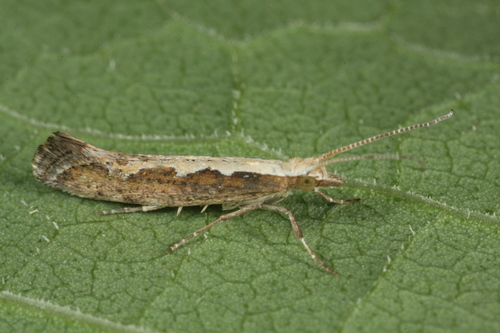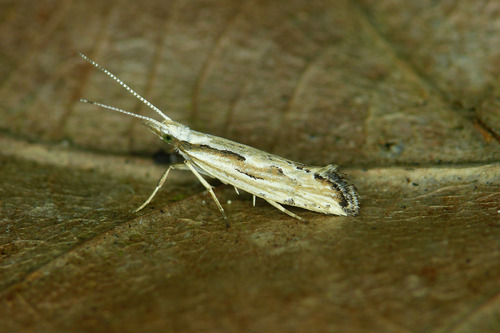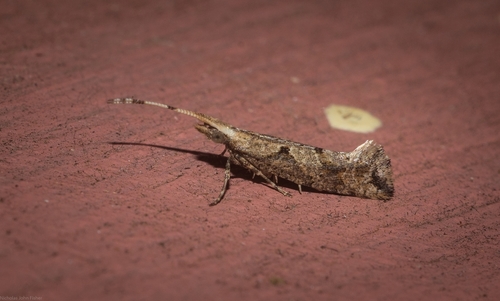
About Leuroperna sera (Meyrick, 1885)
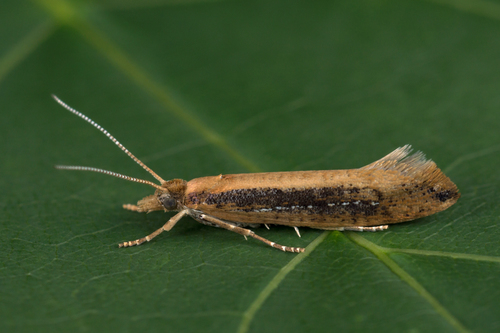
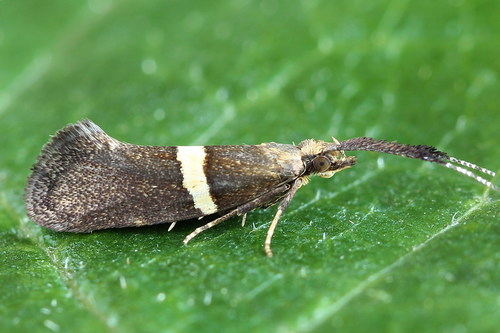
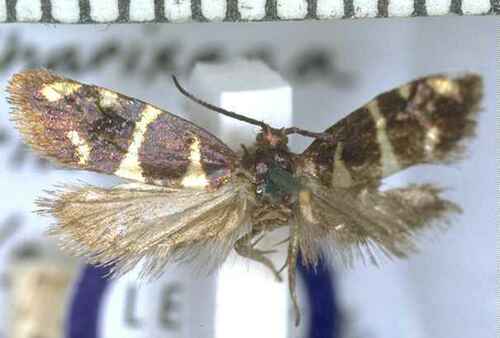
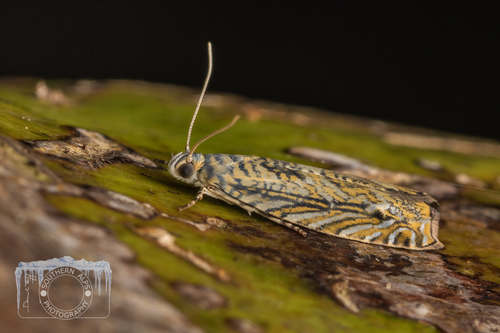
Adult Leuroperna sera (Meyrick, 1885) have a wingspan of 10 millimetres (0.39 in). This species is similar to the sympatric moth Plutella xylostella, but can be distinguished by its much broader wings and distinct genitalia. Mature caterpillars reach a maximum length of about 10 mm. The caterpillar head has numerous blackish-brown dots. Its body ranges from green to yellowish, with slender red or pale red lines along the dorsal, subdorsal, supraspiracular, subspiracular, and basal regions. The pupa of Leuroperna sera is very similar to that of Plutella xylostella, but it has a pair of hooked setae, and its maxilla is always shorter than the mid-leg. Pupation occurs inside an open, net-like white cocoon on the underside of leaves. The caterpillars of Leuroperna sera and Plutella xylostella coexist on shared crop plants. In New Zealand, Leuroperna sera is considered a self-introduced resident species. It is found across the North Island and the South Island as far south as Canterbury, and is regarded as relatively common. In New Zealand, this moth can be observed in a wide range of habitats, including near the edges or clearings of native forest, and in cultivated areas such as domestic gardens. The caterpillars of this species are known to feed on economically valuable crucifers, including Brassica juncea, Brassica napus, cauliflower, cabbage, Chinese cabbage, radish, and turnip, as well as many other wild crucifers. In New Zealand, watercress has been hypothesised to act as a host for this species, as adult moths have been observed swarming over plants in this genus.