About Leucosticte australis Ridgway, 1874
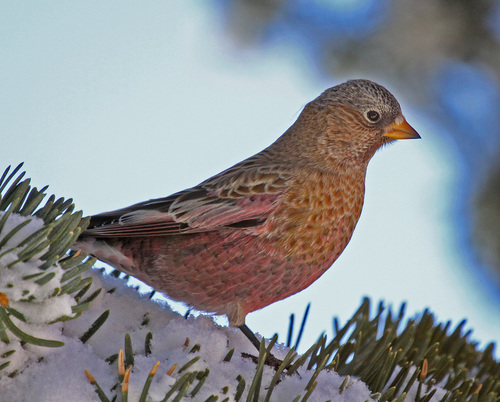
The brown-capped rosy finch, with the scientific name Leucosticte australis Ridgway, 1874, is a medium-sized finch that is endemic to the central Rocky Mountains of North America. Adult brown-capped rosy finches have brown coloration on the head, back, and breast. Their belly and rump are pink, with additional pink shading on the wings and tail. This pink coloration is more pronounced in males, and more subdued in females. The forehead of this species is black or grayish brown. The bill is yellow during winter and black during summer. These birds have short black legs and a long forked tail. Their breeding habitat is located on mountain peaks in the central Rocky Mountains of the United States. They build a cup-shaped nest inside a cavity on a cliff, or they may re-use abandoned cliff swallow nests. After breeding, the female spends three days completing the nest. In winter, these birds migrate short distances to lower elevations. Outside of migration, they can be found in alpine snowfields, and they also visit bird feeders, especially during winter. They forage for food on the ground, but may also fly to catch insects mid-flight. Their diet mainly consists of seeds from weeds and grasses, plus insects. They often feed in small flocks alongside other rosy finch species. At one point, all three North American rosy finch species were classified as a single species. While there were previous concerns that the population of brown-capped rosy finches was declining, a 2023 published analysis found that the species has a healthy population, with more than three times the number of individuals that were estimated in a 2016 report.