About Leucospermum muirii E.Phillips
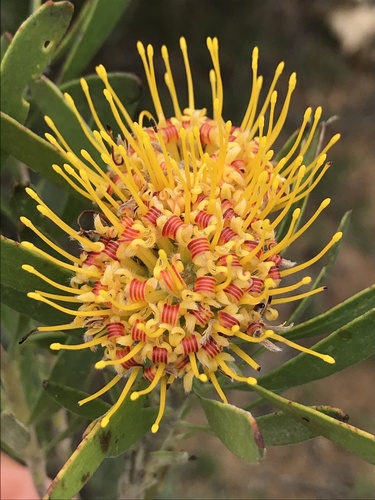
Leucospermum muirii is an evergreen, rounded, upright shrub that reaches around 1½ meters (4.9 feet) in height, and branches from a central trunk. Its flowering stems are slender, 2–3 mm (0.079–0.118 in) thick, and are initially covered in soft grey crinkled hairs that are lost over time. The leaves are nearly linear to very narrowly spade-shaped, 4–6 cm (1.6–2.4 in) long and 4–10 mm (0.16–0.39 in) wide, with three to seven teeth near the tip. Leaf surfaces are initially covered in soft crinkled hairs that are also lost quickly. Flower heads grow individually or in clusters of two to four, are globe-shaped, 2–3 cm (0.79–1.18 in) in diameter, and each sits on an inflorescence stalk 1–2 cm (0.39–0.79 in) long. The common base shared by all flowers in a single head is broadly conical, approximately 1 cm (0.39 in) long and 8 mm (0.31 in) wide. This base is subtended by pointed oval bracts that are 7–8 mm (0.28–0.31 in) long and around 4 mm (0.16 in) wide. These bracts are tightly overlapping, rubbery in texture, and covered in soft greyish hairs. The bracts subtending each individual flower are broadly oval with a pointed tip, about 7 mm (0.28 in) long and 5 mm (0.20 in) wide, rubbery in texture, with dense woolly hairs at their base. The 4-merous perianth is 1¼–1½ cm (0.49–0.59 in) long, and ranges from pale to greenish yellow. The lowest, fully fused section of the perianth, called the tube, is around ½ cm (0.2 in) long, cylindrical or slightly laterally compressed, hairless at its base, and finely powdery where it joins the middle split section (claws), which is also powdery or covered in very short hairs. The upper section (limbs), which encloses the pollen presenter in bud, is made of four narrowly lance-shaped lobes around 2 mm (0.079 in) long. The outer surfaces of the lobes facing sideways and toward the center of the flower head have a tuft of long hairs, while the lobe facing the rim of the flower head has barely any. A straight style emerges from the perianth, 1¼–2¼ cm (0.49–0.89 in) long, topped with a very slight thickening called the pollen presenter. This pollen presenter is cylinder-shaped, around 1 mm (0.039 in) long, with a split at its very tip. The ovary is subtended by four pale yellow, awl-shaped nectar-producing scales around 1 mm (0.039 in) long. Leucospermum belongs to the subtribe Proteinae, which consistently has a basic chromosome number of twelve, with 2n=24. This species is endemic and restricted to the Albertinia plateau, a few miles east and west of the village of Albertinia, extending south to the coast between Still Bay and Gouritsmond, at altitudes between 90 and 250 m (300 and 820 ft). Albertinia pincushion, the common name of this species, only grows on flat terrain of deep white sands, where it can form small dense stands. It grows alongside several Ericaceae species, tall Restionaceae, Leucadendron galpinii, Leucospermum praecox, and Protea repens. It is pollinated by birds. Seeds take around two months to ripen, then fall to the ground where they are collected by ants and carried into underground nests. Adult plants die when exposed to the wildfires that naturally occur in the fynbos habitat where this species grows, but the stored seeds germinate afterward to regenerate the population.