About Leucospermum cordifolium (Knight) Fourc.
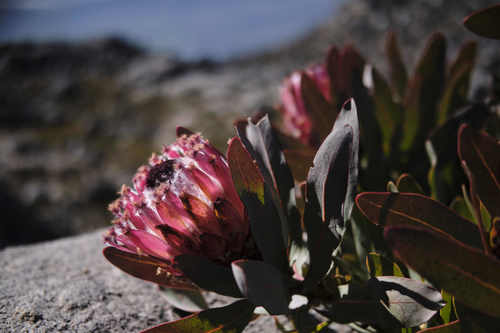
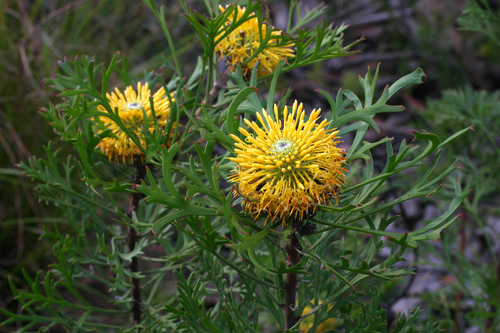
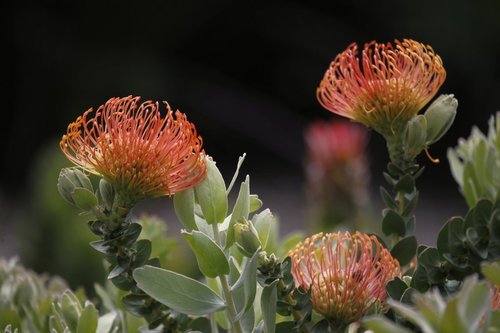
Leucospermum cordifolium (Knight) Fourc. is a rounded, spreading shrub that reaches up to 1.5 meters (5 feet) in height and 2 meters (6.6 feet) in diameter. It grows from a single trunk at the base, with branches that spread horizontally and often curve toward the ground. Flowering stems are 5–8 mm (0.20–0.31 in) in diameter, can be more or less erect or spreading, and are initially covered in short, fine, crinkly hairs that may be lost as the stem ages. The hard, green leaves are arranged alternately along the branches, and generally point upward. Leaves near flower heads are oval or heart-shaped with an entire margin, while leaves further down the branch are bluntly oblong with up to six bony teeth at the tip. Leaves are 2–8 cm (0.79–3.15 in) long and 2–4.5 cm (0.8–1.8 in) wide, softly hairy when young, and become hairless as they mature. Flower heads grow on stalks up to 1.5 cm (0.6 in) long, are flattened globe-shaped with a 10–12 cm (3.9–4.7 in) diameter, and are borne either individually or in groups of two or three, most often held at a right angle to the supporting branch. The common base of the flower head is narrowly conical with a pointed tip, measuring 3–3.5 cm (1.2–1.4 in) long and 0.75 cm (0.3 in) wide. Bracts that subtend the entire flower head are oval with a pointed tip, 4–5 mm (0.16–0.20 in) wide and about 8 mm (0.31 in) long. These bracts overlap and press against the common base, have a rubbery texture, and bear some short, soft hairs. Bracts at the base of each individual flower are concave, wrap around the base of the perianth, and have a pointed, incurved tip. Individual flower bracts measure 8–10 mm (0.31–0.39 in) long and about 7 mm (0.28 in) wide, are rubbery in texture, and are thickly woolly at their base. The perianth is 3–3.5 cm long, and can be yellow, orange, or crimson in color. The cylindrical perianth tube is hairless, and measures 8–10 mm (0.31–0.39 in). Three perianth lobes on the side toward the flower head center remain united, forming a hairless rolled sheath, with only rigid hairs present along the margins. The lobe facing the rim of the flower head is free. Anthers are ovate, and are attached to a 1 mm (0.039 in) long filament. The style is 4.5–6 cm (1.8–2.4 in) long, extends outward horizontally, and curves upward near the obliquely shell-shaped pollen presenter. The pollen presenter has a flattened tip with an oblique groove that functions as the stigma. Four awl-shaped scales around 2 mm (0.079 in) long subtend the ovary. Leucospermum belongs to the subtribe Proteinae, which consistently has a basic chromosome number of twelve (2n=24). Leucospermum cordifolium occurs in a continuous strip stretching from the southeast between Soetanysberg, Bredasdorp, Elim and Napier, Western Cape, through Stanford, Caledon, Onrusrivier and Botrivier, to Aries Kraal in the northwest, in the foothills of the Kogelberg. Unlike its close relative L. patersonii, which grows only on limestone ridges, L. cordifolium is found exclusively on acid soils derived from Table Mountain Sandstone. Individual plants or groups grow in open hilly terrain between 30–450 m (100–1500 ft) elevation, within fynbos vegetation that is mostly made up of other Proteaceae, multiple Erica species, and Restionaceae. Across its distribution range, average annual precipitation is 625–1025 mm (25–40 in), and most rain falls during the winter half of the year. This ornamental pincushion is pollinated by birds. Ripe fruits fall to the ground around two months after flowering. Native ants collect the fallen fruits and carry them back to their underground nests. Seeds remain stored in these nests, protected from fire, and from seed-eating rodents and birds. After a fire clears the overlying vegetation, increased daily temperature fluctuations and chemicals from charred wood that seep to the seeds with rain promote germination, reviving the pincushion population at the site. Tests have shown germination is best when temperatures fluctuate daily between 9 and 24 °C, which matches the microclimate found in its native range during winter after vegetation has been cleared by fire.